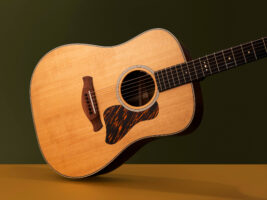
Does tonewood really matter? This is how the wood your guitar’s made of affects the sound
The wood that your guitar or bass is made from affects your tone as much as any other gear choice you make, as much as pickups, pedals and amps. This is especially true for acoustic guitars, with or without a pickup.
Different woods like alder, ash, mahogany and more add subtle nuance to the resulting tone, in turn changing how you play, pick, dig into strings and the harmonic content bouncing around.
READ MORE: Why your guitar’s fretboard radius matters more than you think
There’s countless arguments, discourse and opinions online about how much each component of a guitar affects the overall sound, extending to discussion around factors off the guitar, such as player’s hands, technique, feel and more. Discourse aside, what is true is that everything matters.
While different woods have different amounts of impact, each component affects sound, which in turn affects feel, affecting technique and subsequently the final signal that has passed through the guitar to an amplifier or out of a soundhole. Even the most simple guitars might have a handful of components doing 1 per cent each, but 20 of those leads to a 20 per cent variance between sonics and sound— a huge amount when you think about it!
The weight and feel of the guitar is largely at the behest of the woods it’s made from, both the body, neck and fretboard, and these also feature wildly different tonal characteristics because of structural integrity, quality and weight.
Image: Adam Gasson
Fretboards
Fretboard wood varies a little less than body wood, so let’s start there. Many guitars feature either rosewood or maple fretboards, though ebony is another common, albeit premium, choice. Various woods like purpleheart, or amaranth, ovangkol and pau ferro are all often used in situations where rosewood is unavailable, either because of logging restrictions or cost prohibitive situations.
Rosewood is used extensively on electric guitar fretboards. Being a softer wood, it absorbs certain frequencies and accentuates others, often being known for a warmer, more midrange sound, making it a great choice for a mid range instrument like the guitar. Brightness is retained in a controlled way, while low end melts away a little bit without the resulting sound being overtly thin.
Maple is a harder wood, and while retaining the mid range character of rosewood, its bright disposition is thanks to the snap and attack of your playing bouncing off the hard surface instead of vibrating away into the wood. This is augmented by the glossy finish on many maple necks, used both for tone, as well as to protect the clean, light-coloured maple from getting grubby.
Ebony is again, even harder than maple, and is particularly bright, the grain almost invisible on premium cuts of ebony. While rosewood has visible grains and imperfections in the wood, ebony usually offers a particularly glassy finish, both aesthetically and sonically. Furthermore to your choice of wood, designs like a one-piece maple neck can prevent tone from fizzling away between components. While a rosewood fretboard is often glued to a maple neck, for example, the tiny gap between neck and board allows vibrations to escape, while a single piece of maple that serves as neck and fretboard has no gap for that sweet, sweet tone to escape to!
Image: Adam Gasson
Perfect Pairings
Pairing your fretboard wood with body wood can help to shape and refine the sound. More common warm guitar woods like mahogany for electric guitars or rosewood for acoustic guitar can be paired with snappier fretboards for a controlled tone, while matching a warm fretboard with a warm body wood can provide a more mellow, vintage, mid-range focused sound.
Mahogany is commonly used on Gibson’s Les Pauls, paired with a rosewood fretboard, or ebony on the Custom range. Fender uses alder extensively to provide weight relief compared to the hefty mahogany Gibsons. Alder provides a nice middle ground that harnesses the punch of a rich, firm wood, while its lightness allows a little mud and low end to fizzle away. Fender also commonly uses various species of Ash, even lighter and brighter again, paired with warmer fretboards.
These subtle differences are augmented further by your choice of pickups, so be weary of those pairings! The wrong choice of pickups can either miss out on the richness of your wood, or augment to the point of harshness.
Image: Adam Gasson
Acoustics
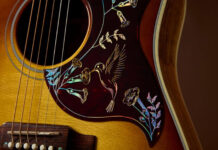
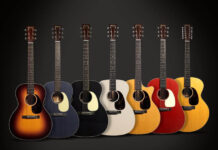
These choices are even more obvious on an acoustic guitar, guitar makers pairing different woods for the top, sides and back of the guitar. These choices, along with the soundhole, serve as the guitar’s amplifier and affect the sound entirely. Variations of maple are commonplace in modern tops for acoustic guitars, the bright demeanour of the wood being perfect for clarity in playing.
More vintage-style acoustics, like parlour guitars, sometimes use rosewood for the top and sides resulting in a warmer, more dimmed sound that allows the mid range to shine through. Both rosewood and ebony are common on acoustic guitars, though the brightness of maple is often overkill for the brightness of acoustics, the resulting sound being brittle and harsh.
The character and controlled acoustic qualities of a tonewood come together in semi-hollow guitars, some of which have a comb of standard electric guitar pickups and piezo systems. The timbre of the tonewoods in semi-hollow electrics harness woods like alder and ash, usually reserved for solid body electrics, tying together acoustic resonance and controlled, mid-forward chime.
While tonewood may have a small effect on its own, the way they allow or prevent vibration from escaping into the ether have a huge effect on the resulting sound. Different designs allow sound to vibrate away differently, either pushing brightness into your pickups or mellowing it out entirely. Harder and softer woods offer brighter or warmer sound respectively, and your choice of body wood yields the same results, this being exacerbated in acoustic guitars because they act as both guitar and amplifier as sound bounces out of the soundhole.
In the pursuit of your perfect sound, you’ve also got to try different tonewoods to see what matches your style, technique and feel, different woods either being great to augment your own playing, or to harness different tonal tools for different jobs. There’s no right answer for everyone, but there might be a wrong one, so try as many guitars as you can.
The post Does tonewood really matter? This is how the wood your guitar’s made of affects the sound appeared first on Guitar.com | All Things Guitar.
Source: www.guitar-bass.net