Laney Prism-Mini review – a sub-£100 desktop amp with sounds that’ll rival your main rig
£99/$149, laney.co.uk
As a lover of all things digital – and convenient – I’m perhaps better poised to appreciate the world of uber-compact smart practice amps than my tube-loving colleagues. A practice amp is an essential in any player’s gear collection. When a riff idea springs to mind, you can’t be dialling in your pedalboard or loading up your DAW; you need to workshop it right away before it’s lost to the ether. Having a small, portable and easily set-up amp on hand can be a creative lifesaver.
READ MORE: HeadRush FRFR-12 and FRFR-8 Cab review: “looks and feels like a real guitar amp”
So when the Laney Prism-Mini arrives, I’m instantly intrigued by its promise to squeeze plenty of big amp features into a tiny enclosure. Let’s take a closer look…
What is it?
The Laney Prism-Mini joins an already-packed market of mini practice amps, and fights for space against such titans of the category as the Positive Grid Spark GO, Blackstar Fly 3 and the Boss Katana-Mini.
Laney has plenty of expertise in this world however – its Mini and Mini Stack amps have earned plenty of fans thanks to their ability to produce a simple and straightforward Laney sound in a tiny little package.
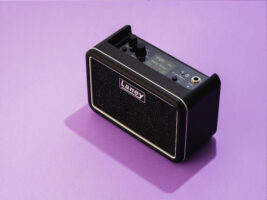
The Prism is something rather different however – this is a full-on modelling amp with all the versatility and depth that involves, but in Coke can-sized package. In practice that means you get 17 onboard amps and 32 effects, plus an onboard drum machine and tuner – a whole lot of stuff for a tiny little amp.
As you’d expect, the amps onboard include emulations of Laney favourites like the Lionheart, Ironheart, Cub and Digbeth, plus the usual off-brand suspects. The effects span reverbs, delays, drives, EQs and modulation effects, up to six of which can be run simultaneously. You can save up to 100 presets as well, so you don’t need to worry about forgetting your favourite tones.
As you’d expect for a modern practice amp, you can hook your phone up to it via Bluetooth to stream music wirelessly, while there’s also a 3.5mm headphone jack for quiet practice, and a USB-C for charging the built-in battery.
In terms of power, you get a pair of 1.5-inch stereo drivers putting out 3 watts each for 6 watts RMS in total. The amp has onboard control and a full-colour LCD screen for tweaking your sound on the fly, but for deep editing you’re probably going to want to hook it up to Laney’s Tone-Wizard smartphone app.
Image: Adam Gasson
Laney Prism-Mini – build quality and usability
The first thing that strikes me about the Prism-Mini is its light weight – barely tipping the scales at half a kilo (0.535kg/1.2 lb), it’s very easy to stow in a bag or even your pocket, should your trousers be of the cargo variety.
There is a flipside to this of course – one that often plagues these smaller amps with top-mounted controls. Its centre of gravity is such that it’s very simple to tip it over, and all it takes is one ill-considered tug on the cable and its taking a nose-dive towards the hardwood. Mercifully, it seems pretty capable of withstanding a three-foot drop onto a hard floor, but it’s not a trick I’d want to repeat too many times.
The amp could have been made more stable with the addition of some more sturdy rubber feet, or taking a leaf out of Blackstar’s book and sticking the input jack on the bottom of the amp instead of the top. Even adding a little more ballast internally might have helped things here.
Stability concerns aside, my first impressions are very positive. It feels rugged and well-built in the way Laney’s stuff so often does, and its all very clearly laid out, with just a volume control, infinite-scroll parameter wheel, and a back button to control what’s occurring on that colour LCD screen.
This is unquestionably a little fiddly – the lack of any kind of tone controls means that it’s not the most tweakable amp on the fly, but actually navigating the various patches is pretty intuitive via the 1-inch screen.
Image: Adam Gasson
Speaking of the screen, one hiccup I’ve noticed is that it’s pretty small – by design, obviously – but that fact it’s mounted on the top of the amp, and the nature of practice meaning the amp is often on a tabletop, means I find myself standing to a partial squat position in order to see what’s on the screen more clearly. Less of a problem if on a lower surface like a coffee table, but something to consider.
To get the most out of it however, you really do need to download the Tone-Wizard app, which makes the whole tone-shaping process much more intuitive – you can then save your presets and scroll through them quickly on the amp itself. There’s impressively little latency between the phone and the amp, too, so you can tweak your tones in real time without any hassle.
Equally impressive is the battery life – Laney claims 14 hours of continuous playtime on a single charge, and in practice this held up. Having charged it to full upon its arrival, I didn’t have to plug it in once during my entire testing period.
Another winner for the Prism-Mini are the looks – you can opt for a stealthy all-black affair with white piping and silver-flecked grille, or a blue and basketweave option that apes the Lionheart. Either look great, and strike the right chord in terms of classic British amp aesthetics.
Image: Adam Gasson
Laney Prism-Mini – sounds
Growing up, I’d come home every night from school, plug into my Roland Micro Cube, and shred that thing until I went to bed. It’s been a few years since then, and digital amp modelling has come along leaps and bounds, so I wasn’t surprised by the quality of the sound that emits from the Prism-Mini, but they’re still very impressive.
To recap, there are 17 amp models included with the Prism-Mini, plus 50 factory presets (and 50 slots for saving your own). These presets run the gamut in terms of what any average guitar player will be looking for, with a high-gain highlight coming with #14: Solo AyIt – I’ve lost a good few hours shredding some reverb-laden solos on this one – #1: Stratic! as a solid clean option, and #20: Funk as a wild card… These are some personal favourites, but you’ll be hard pressed to find a preset among the 50 that doesn’t sound good.
The stereo speakers sound great, giving a nice wide spread of sound, and offering more than enough volume for home use. Crank it up to the highest end of the volume knob however, and you start getting some sympathetic rattles and vibrations from the enclosure that are quite unpleasant. It’s the nature of a smaller amp that bass frequencies will get a bit muddy however, and I’d be surprised if many people were dimeing the volume in general use – it’s pretty loud!
Image: Adam Gasson
Laney Prism-Mini – should I buy one?
There’s space for an amp of this size in every guitarist’s arsenal. The Laney Prism-Mini is hardly going to become your main guitar amp, but the ability to grab it and set it up anywhere makes it indispensable for workshopping riff ideas as they come to your head. That said, having a solid tone while working on riff ideas is surprisingly important; you’ll play in response to your tone, so a better one means you’ll be more creative and come up with better ideas. So you can rest assured that the Prism-Mini comfortably meets that requirement. And for less than £100, it’s hardly an expenditure that’ll leave you bankrupt.
Laney Prism-Mini – alternatives
At a similar price point (£95 compared to the Prism-Mini’s £85), the Positive Grid Spark GO jumps out as the most obvious contender here. Like the Prism-Mini, it’s also an uber-compact desktop modelling amp, and also comes with a companion smartphone app for crafting your tones. When the Spark GO arrived in 2023, we gave it a 9/10 review, calling it a “remarkable feat of engineering”. Alternatively, by springing a little extra (£135) for the NUX Mighty Air, you’ll get an additional four watts of power, plus an included wireless transmitter, meaning no cables, and no amps falling off tables! This one also comes with a wealth of built in amp models and effects including all your typical delays, reverbs and modulation effects. Another option in the same category is the Pulze Mini from Hotone, which offers a similar form factor and suite of digital amp models, but in a classy cream enclosure. If you want the best sounding mini-amp and are prepared to spend a little more, the Blackstar Beam Mini offers access to the high-end NAM tone library in a compact package.
Learn more about the Prism-Mini at Laney.
The post Laney Prism-Mini review – a sub-£100 desktop amp with sounds that’ll rival your main rig appeared first on Guitar.com | All Things Guitar.
Source: www.guitar-bass.net