Fender Vintera III Mid ’60s Jazzmaster review: Mexican-made vintage-style offset bliss
$1,349/£1,149, fender.com
It’s strange to think that a few years back, what classed as a bad PR situation for Fender was them shipping the American Vintage II Jazzmaster with a not wholly vintage-correct headstock shape. Simpler times.
Here in 2026, you’d probably forgive Fender taking its eye off the ball a little given everything else that’s going on, but it’s worth remembering that the people actually making and designing these instruments are primarily focused on what they always have been: building the best-sounding, feeling and playing instruments they can at price points that suit pretty much every budget.
READ MORE: Fender Vintera III Mid ’60s Jaguar review: “this is the guitar Jaguar fans have been asking Fender to make for years”
The aforementioned AVII headstock snafu was just the latest in a series of incidents where Fender was accused of not quite getting the offset thing by its invariably exacting devotees.
The first Player Jazzmasters, for instance, could have been the best-made guitars on the planet – they were never fully embraced by fans because they had slightly naff-looking open-coil humbuckers in them, and no rhythm circuit. And look, the guy in the demo video didn’t even touch the vibrato, nor did he put the thing through two reverse-reverbs and six fuzzes – do you think he’s even heard Loveless?
A lot has changed since then however, and Fender has done much to make up to the Jazzmaster faithful in the years since – things are undoubtedly better now across the board, but especially in Fender’s Mexico-made Vintera range.
In fact, so good has Ensenada got at making Jazzmasters now, that my colleague Josh felt emboldened to declare that the Road Worn Vintera II guitar he reviewed back in January was “the best all-round Jazzmaster proposition in the Fender range.”
What is it?
The Vintera III range is Fender’s latest attempt to do something that a huge cohort of players want and need the brand to do more than anything else – creating guitars with vintage specs, looks and sounds that don’t require you to take out a small business loan to afford.
It’s been just three short years since the Vintera II launched, however, and there was very little wrong with the old guard, so what’s changed? Well, Vintera III promises to give us an even more take on the vintage JM thing – eschewing the loose decade-spanning scope of the old guitars and focusing on a specific inflection point in a guitar’s development, in this case the mid-1960s – aka the moment that Jazzmasters really started to get fun with custom colours, painted headstocks and the like.
The core sell of the Vintera range remains unchanged – this is a guitar with most of the ‘right’ vintage appointments that’s not so cheap you might as well just get a Squier, and not so expensive that it’s totally beyond the scope of many musicians.
That doesn’t mean it’s cheap, however – sticker shock has come for guitars in a big way over the last few years, and ‘mid-priced’ in Fender terms now stands for $1,349. That is no small number for anyone really, but it’s broadly in line with the guitar it replaced at least – there’s no wince-inducing global inflationary crisis gut-punch that saw hundreds of dollars added to the base price between Vinteras I and II.
While the improvement is clearly iterative with Vintera III, the offsets have changed more than most. Crucially, while the Vintera II Jazzmaster recreated a late-1950s instrument, for III we return to the mid-1960s style of guitar – similar to the first 2019 Vintera run.
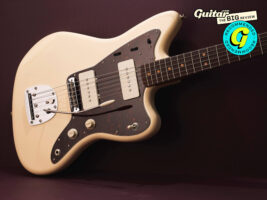
As mentioned, that means we have more fun finish options than previous editions – Sonic Blue and Candy Apple Red for those who want matching headstocks, and an Olympic White option – our guitar for today – that comes with a plain headstock.
Image: Adam Gasson
The latter is a bit of a shame in my opinion as most real Olympic White Jazzmasters from the mid-60s also sported a painted peghead… at least it’s the right shape? Mid 60s also means that we don’t get the bound board with block inlays that came later in the decade – maybe Fender will save that for Vintera IV?
The company’s product page notes a few differences as to how it’s going about the whole “vintage” thing this time around – no real revolutionary changes, but just an overall upping of the focus and detail – the headstock decals are now being applied over the finish, and we’ve got a period-accurate round-laminated rosewood fretboard rather than a slab board, clay-coloured fretboard dots rather than modern white ones, and a real bone nut instead of a synthetic one.
Hardware, electronics and the neck profile are all now “era-based” rather than “decade-based”, which makes sense, given that a “mid-’60s Jazzmaster” can mean a hell of a lot of different things. Fender doesn’t go as far as to put a year on it, but the specs and finish options add up to something approximating, at the latest, a ‘64 Jazzmaster, as bound necks would be introduced in 1965, and the big block inlays/big headstock combo would follow in 1966.
There’s still one major concession to price, in that the finish is poly rather than nitro – no authentic ageing experience for you here. Maybe, like with Vintera II, Fender will wait a year or so and then roll out a road-worn variant with a lightly-aged nitro finish for a little more cash, but until then, we’re strictly in polyurethane town.
Not that the poly finish looks bad, by any means – the Olympic White example I’ve got here is a lovely deep off-white – the white Squier Classic Vibe Jazzmaster next to it in my guitar rack looks as rich and inviting as a sheet of printer paper in comparison.
As a whole the guitar presents very well, and small as they are, those vintage-correct details do have a cumulative effect. The clay dots, for example, really bring the look of the neck together, especially given the rosewood ‘board. On our review example, this rosewood is a chocolate colour so rich and deep I am more than a little tempted to take a bite out of it. Even the three-dimensional nature of the headstock decal being placed over the finish – a detail that seems comically minor on paper – adds a bit of vintage panache to proceedings.
Image: Adam Gasson
Build quality and playability
I spend a lot of my time playing fairly modern-feeling necks – not quite multi-scale Strandbergs, but at the very least 9.5” boards and jumbo frets. And so getting my mitts around this mid-60s C-profile neck, with its 7.25” radius and vintage-tall frets, is a surprisingly refreshing affair. It is, of course, no slim shredder, but no less comfortable because of this. There’s enough heft to reassure me that I’m actually holding something, but it still allows for some relatively fast movement.
And while it may not be the perfect playground for sweep arpeggios, leads of a less flashy breed are still a hell of a lot of fun – the vintage tall frets are, well, tall, and are therefore great for digging into the side of a string when bending. Down by the headstock, the more curved surface is a lovely affair when fretting big whole-neck chords.
The setup and fretwork in general are great, with no dead spots to speak of and a nice low action. Fender has also continued its trend of gently rolling its fretboard edges, which makes for a supremely comfortable feel, especially when you launch into a big bend that requires hanging onto the neck for dear life, or land on a big open G with less than perfect positioning – the fretboard edges just melt out of your way.
That’s the left hand – at the right hand, the vibrato is the star of the show, as you’d hope from a classic-spec’d Jazzmaster. I find its factory setup pretty dead-on, with a smooth action for some nice woozy pitch-wobbling and just the right amount of tension on things to make it feel responsive and tactile rather than stiff and unwieldy. The rocking bridge also does its job of keeping things in pretty good tune, even after veering into some over-egged wanging on the bar. The push-in arm also stays where I want it, and if I want to move it out of the way, I can do so silently – it does not, as some bars do, creak like the gates of a gothic castle as you move it about.
Image: Adam Gasson
The one big caveat is this: even sticklers for vintage accuracy would be happy to ignore the anachronism if Fender just admitted defeat, and put a Jaguar bridge on this thing. The threaded saddle bridge has its adherents, but let’s be honest, quite a substantial chunk of offset players will replace theirs by default. There’s a reason the aftermarket Jazzmaster bridge world is absolutely chock-full of options. Fender even makes its own relatively decent mid-priced barrel-saddled option.
We’ve already made one concession to modern player comfort over vintage accuracy, in that these guitars come with 0.010s rather than the heavier strings that work best with the Jazzmaster’s rocking bridge/vibrato combo – so why not just take that extra step, save everyone a few quid, and avoid dooming the stock bridge to rot in a drawer somewhere?
Luckily it’s not a total write-off – the threaded sample example found here does at least function with the factory setup… mostly, as I still occasionally push the low E out of its slot. I’ll put it like this – if I was aiming to make this my main gigging guitar, I’d still seek to replace the bridge as soon as I could, but I wouldn’t shy away from playing the guitar live while said replacement was in the post.
One final gripe – the knobs are still set wrong. When I look down, and the guitar’s on full, I see 4, 5, and 6 – seemingly to let the “volume” and “tone” labels be parallel to the neck. I’ve no idea why they ship like this, because unless you’re playing it like a lap steel you’re not going to see those labels. Everyone else seems to agree that when you look down at a guitar, you should see the number 10 to indicate that you’re on 10. Is this splitting hairs? Yes, but it’s hair-splitting that does actually affect your out-of-box playing experience – if we’re caring about headstock decals being under or over the finish, we’re caring about this, too, Fender!
Image: Adam Gasson
Sounds
The pickups and electronics are fairly straightforward – no noiseless pickups or fancy switching here, unless you count the near-70-year-old rhythm circuit as a fancy addition. The lead circuit provides all of the spank and the punch you’d want from a Jazzmaster, with a bridge pickup that’s nice and bright but by no means an aural ice-pick, and a rounded, warmer neck pickup that’s got quite a present upper midrange.
The output here is relatively low – perhaps not as low as you might expect from some true vintage examples, but far from any sort of modern, hot pickup output. This does mean that there’s a good amount of dynamic range to be had on clean to lightly-overdriven sounds, even if you’ll want to up the preamp gain somewhere along the chain to compensate – and, on the other end of the spectrum, there’s a surprising amount of breadth and clarity when throwing stacked fuzzes, reverbs and delays at both lead positions.
And speaking of such an activity, the rhythm circuit does its thing, which you will find either unusably muddy or an excellent combination with the aforementioned wall of fuzz and delay, depending on your Jazzmaster preferences. Divisive it may be, it’s still a Jazzmaster, and for many it wouldn’t be complete without it – even for those who dislike it, masking off the switch can be part of the ritual. At this point, a couple of inches of electrical tape should come in the case alongside the vibrato arm…
Personally I find the rounded character of the neck pickup makes the rhythm circuit a pretty usable proposition for both smooth leads and messy Kevin Shields impressions, but for pretty much everything else the brighter, clearer sounds of the lead circuit are more likely to do the trick.
Image: Adam Gasson
Should I buy one?
If you own a Vintera II Jazzmaster and you like it – I wouldn’t be in a rush to add an extra ‘I’ to the proceedings, unless you’re desperate for a switch to the 60s spec. However, it’d be wrong to expect Vintera III to totally reinvent the Jazzmaster wheel – that’s not really the point of a new range of Vintera guitars. There are only so many ways to skin the particular cat of an 1964-ish Jazzmaster for this price, and with this in mind it’s very nice to see the focus being placed on sharpening the vintage details. These details are packaged up in an extraordinarily well-constructed instrument, one that successfully builds on the successful points of the Vintera II JM.
Even with that upwards shift of the definition of a “mid-priced guitar”, the Vintera range remains a very good bang-for-buck proposition within Fender’s lineup. If you can get over the poly finish, this is as accurate and as playable as you’re going to get if you want a vintage-spec’d Jazzmaster for anywhere this side of £2,000. Or quite a bit more for the real deal. Of course, that accuracy is both better and for worse, perhaps, in the case of the bridge, but hey, what would a Jazzmaster be without a little obtrusiveness?
Vintera III Jazzmaster Alternatives
If you want a similar experience but fancy that nitro finish, some Road Worn Vintera II 50s Jazzmaster models ($1,699/£1,399) are still available in a few places. If you are an offset fan of a slightly different stripe, Vintera III has also arrived with a Jaguar offering ($1,34.99/£1,129). If you want to save a bit of cash, the Player II Jazzmaster offers a relatively authentic but no less enjoyable Jazzmaster experience for very decent price ($879.99/£759), and if you want to go the whole hog and nearabouts double the price tag, you can look at the American Vintage II 1966 Jazzmaster ($2,799/£2,379) now with the right headstock.
The post Fender Vintera III Mid ’60s Jazzmaster review: Mexican-made vintage-style offset bliss appeared first on Guitar.com | All Things Guitar.
Source: www.guitar-bass.net