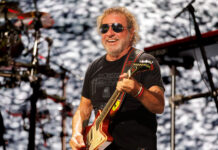
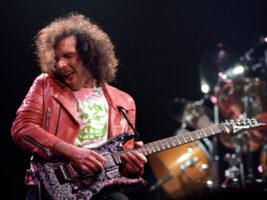
“It was just so difficult and insane” Joe Satriani tells the story of his favourite guitar solo
In terms of sweepingly melodic, transportive bliss, few rock instrumentals match the dizzying heights of Joe Satriani’s title track to his 1989 album, Flying in a Blue Dream. Yet behind the song’s weightless, majestic feel was a period of grueling physical, creative and personal chaos. Not only was Satriani coming off a punishing year of touring and recording, but he was also dealing with the grief of losing his father and grandmother. At the same time, he was battling an undiagnosed intestinal illness that left him constantly running to doctors.
READ MORE: “We’ll never stop doing what we do”: The Linda Lindas on the power of community, working with Hayley Williams, and becoming toneheads
“It was just so difficult and insane,” Satriani recalls, “but there was also this enormous amount of creativity. I went on tour playing guitar for Mick Jagger, and at the end of the tour I picked up Giardia in Southeast Asia, only I didn’t know it for a while. They looked at everything from my appendix to my brain – every time they had an idea about what was wrong with me, it was always wrong. And then my father had a stroke and went into a coma – he passed away. My grandmother passed away a few weeks after that. It was so stressful and crazy.
“And then I had braces on my teeth that year, for TMJ, which was bad timing to say the least,” he continues. “But every time it got rough in the studio, all I’d have to do is close my eyes and think, ‘Remember when you were on tour… That’s the biggest gift the universe has ever given you.’”
Not Giving Up
Satch’s stubborn refusal to give up fueled the marathon sessions for what would become his landmark third studio release. Coming off the unexpected success of 1987’s Surfing with the Alien, the guitarist found himself armed with a real budget and a newfound sense of artistic freedom. “That went into us not giving up on the record,” he recalls. “[Co-producer] John Cuniberti was extremely patient with me. We went into it with a bigger budget, thinking, ‘Wow, we can sit here for three months straight and just record.’ Of course, after three weeks, it was like, ‘I can’t take this. It’s just too much work.’ It was 10 hours a day, with me being the only guy playing everything – and all this other stuff was happening. I was quickly getting burned out.”
Out of that pressure cooker came a track that was less of a conventional shred showcase and more of a carefully paced cinematic journey. Built on a looping, open-F acoustic groove, the piece weaves through changing Lydian keys while anchored by a central, unwavering melody. It opens with an unmistakable fragment of ambient serendipity – a snippet of stray radio interference caught on tape – before soaring into a lead section that mimics the deliberate pacing of a classic crooner rather than a speed-demon virtuoso.
What makes the centerpiece solo on Flying in a Blue Dream so enduring isn’t just its technical brilliance; it’s the way Satriani uses vocal-like phrasing, controlled feedback and clever key changes to give the listener the literal sensation of flight. In place of rapid-fire aggression, Satriani approached the piece with the patience of a storyteller, holding back until the absolute final moment to let the guitar fully break free.
Going into Flying in a Blue Dream, your life had completely changed. With your initial EP in 1984 and your debut album, Not of This Earth, virtually nobody knew who you were. Then Surfing with the Alien blew up, and you were out on the road with Mick Jagger. Was it surreal or intimidating trying to follow up that kind of breakthrough?
“It was such an amazing turn of events to go from making my first EP in ’84, which was a complete avant-garde experiment of guitar, and then Not of This Earth in ’86. The perception that Surfing was my first album is correct in a way, because the EP and Not of This Earth were so undersold that only the craziest people knew those records. When John Cuniberti and I made Surfing, it was under duress, and we really felt like it was the record that would get us kicked out of town once we handed it in.
“But the exact opposite happened. Not only did I go on tour as a solo artist, but I got to play with Mick Jagger on two high-profile tours. Going into the next record, I had real-life experience playing instrumental music in clubs and at the Tokyo Dome. When you get real experience playing for people, it informs you about what works and what doesn’t. When you’re in your bedroom or basement, you imagine, ‘Oh, this is going to kill. When I play this part, people are going to jump up and down.’ But then you go out there and you get a different response every night, and you’re left thinking, ‘What did I do right? What did I do wrong? Was it the sound? Was it the mix? Or was I staring at my shoes?’
“So going into the record, I felt there was this extra confidence that I had. John and I thought, ‘They got it. People understood what we worked so hard to put into Surfing. That means we should keep going. We should not step back, we should not repeat – we should just keep pushing the envelope as far as we can go.’ That’s why the record wound up with 18 songs on it and six vocal songs. It was insane. What I should have done was just make Surfing with the Alien Part Two, but the experience of playing live was so important to being able to walk into the studio and bring that confidence.”
Where did the actual spark for the title track come from? Was it a melody you’d been carrying around, or did it hit you out of nowhere?
“I was in my apartment in Berkeley, working on songs for the album, which had no title yet. I was working on a song called Big Bad Moon that I had written mostly in my van – the Squares’ van, as we used to call it – and I was struggling with the lyrics. I was thinking, ‘How am I going to sing this thing? That’s not me. That’s not my voice.’ I had to step away from it.
“I had a memory of when I was a kid, having these flying dreams as I was trying to go to sleep. It just filled me with a kind of musical inspiration – I don’t know how to put it into words, but I suddenly picked up this acoustic guitar and I heard these chords. I tuned the guitar to an open F for some reason – maybe because I kept thinking a low C was the note I was hearing in my head – and I started playing these chords that sounded right to me.
“After the whole musical part was mapped out, the analytical part of my brain looked at it and went, ‘That’s really interesting. You’ve never done that before.’ Physically, as the guitar player with an open-F tuned guitar, you’re playing in different Lydian keys throughout because you’re repeating the exact same chord pattern and just moving it around. But as the person doing the melody, you’re weaving through on key, letting people know it’s an easy, beautiful ride – it sounds like you’re always in the key of C as things move around. And don’t pay attention to the rhythm guitar player, whose hands are going to kill him by the time he gets to the end of the song because he’s playing these open-tuned bar chords over and over. [Laughs]”
How did the initial demo take shape from that moment in your apartment?
“This was all happening minute by minute that afternoon in the apartment. I got so excited that I completely forgot about Big Bad Moon and just focused on this. I had my Tascam four-track cassette recorder – a great, fun little deck – and I was busy recording bits of it as I was writing.
“When I finally got to listen to the whole thing all the way through, the funniest thing came to my mind: Frank Sinatra. Very often, Frank would start a song and tell you a story in a colloquial, American spoken way of singing. By the end of his melody, not only would the register move up and up, but he’d finally say the word that is the chorus at the very end. I thought, ‘That’s my model. That’s what I have to do here, because I’m telling a story, but it’s about flying.’ As I get to the height of the story, I need to be high up in the sky flying around.
“I started to think, ‘Just pace it the way that Frank Sinatra would’ve paced it. Go slowly, go way behind the beat, just go late, late, late, and then move your way up.’ Things come together as the melody gets higher and higher and finally ends on the highest note you can sing. Every time I would explain this in the studio to John Cuniberti, he’d look at me like, ‘Really?’”
How exactly did you present the song to John, and what was the tracking process like?
“I’d play the stuff for him right there that morning. He’d come in and go, ‘What are we doing?’ The way the record proceeded from square one was like this: Joe comes in, we do time code, we lay down a guide drum machine, and then depending on the song, I will play either a bass part, a keyboard part or a guide rhythm part. We build from there, and melodies and solos are the last things that we do.
“The odd thing about this particular song is that we recorded across so many locations. We started at Different Fur in the Mission District in San Francisco, then moved to Coast Recorders right on Mission Street, then moved to Fantasy Studios in Berkeley, and we finished at Alpha & Omega on High Street. Even though San Francisco is a small area, it felt like we were moving around constantly.
“We laid down just a guide drum thing, I laid down the bass part using a ’64 Precision Bass with the low string down to C, and then I laid down the acoustic guitars. The only drum fill in the whole song is a backward cymbal leading into a real cymbal crash that Jeff Campitelli did for us. It’s a very minimal, funky, automated vibe.”
The song opens with that incredible broadcast voice coming through the amp before the music hits. How did you end up capturing that stray radio signal?
“That happened at Coast Recorders. We were setting up to record some distorted rhythm guitars for the long fade-out, just to give it some chunky guitars at the end. We got a good, chunky sound, but every time I turned up the volume control, I got radio, television, taxis… It was unbelievable how much interference we got at that studio. It was a great room, but they weren’t used to high-gain guitar players coming in to record.
“We were sitting there laughing, like, ‘How are we going to record this part if it’s so noisy?’ Every time I turned the volume knob from two to three, I’d get a different radio station. At one point, we heard this kid’s voice coming through, talking about something. John and I thought it sounded like an old 1950s Art Linkletter radio show or TV show from when we were kids.
“This song was the first track on a reel of tape, which meant there was leader tape for 10 or 15 seconds before the 15 minutes of recording tape began. John immediately just pushed record. We didn’t know how much would get recorded on the leader, but we just stood there listening to this kid talking. As soon as the kid gets to the point where he says, ‘…and sometimes afterwards they like each other, and sometimes they don’t,’ the leader ended, the magnetic tape hit the heads, and the guitar chords came pounding in. We were like, ‘Damn!’ The timing was just too good to be true for a song written about being a kid having flying dreams.”
In terms of the guitar tracking, how many guitars are actually weaving in and out of the arrangement as the song builds?
“It’s layered in a very specific way. You have the bass guitar and two main acoustic guitars playing most of the rhythm parts – I used a Yamaha electric-acoustic for those main chords. Because of the open-F tuning, when you get to the bridge of the solo it required different tunings because it was fretted notes and open strings at the same time. It was tedious punching in, but you have to focus on the goal. During that bridge section, I added acoustic guitar harmonics, so at that point there might be three or four acoustics playing at once.
“Then, when I get to the penultimate spot of the melody, a second electric guitar comes in that doubles the high notes. The two crunchy, distorted rhythm guitars don’t actually come in until the very end of the song during the ride-out.
“What makes it feel like guitars are constantly appearing and disappearing is how the melody sections hand off to one another. One section will end on a long, sustaining note, and while that note is hanging in the air, another guitar track comes swooping in underneath it to take over the next phrase. It creates this seamless, soaring relay effect where the lead voice never seems to touch the ground.”
Before the main solo kicks in, there’s that wall of control-room feedback. How did you execute that so precisely?
“When we moved over to Studio D at Fantasy, we were listening to the track and we loved how it was turning out, but we wondered how to introduce it. We thought, ‘Let’s lead into it with feedback.’
“I was using the prototype for my JS model – the Ibanez ‘Black Dog’ – plugged into an old Boss DS-1, running into my Mesa/Boogie Mark II C+ head. I was in the control room, and John miked up the cabinet in the live room. We came up with a system where I put strips of tape alongside the mixing console on the floor. Standing in specific spots relative to the studio monitors allowed me to hit exact harmonic overtones – a fundamental here, a major third two feet over, a fifth over there. We figured out we could play the feedback like it was a keyboard or a standalone instrument, getting actual musical notes rather than just random noise.”
The centerpiece solo is a bit hard to define structurally because the song flows like one unbroken stream rather than a standard verse-chorus-solo layout. How did you view the arrangement?
“It’s a pretty funny arrangement. The solo actually takes place over the verse pattern, but I put the bridge of the song inside the solo section. In instrumental music, you can’t always arrange a track like a vocal song – verse, verse, chorus, bridge, solo. In this case, it goes verse – ending in a chorus phrase – then the solo starts, the bridge happens within the solo, and then it goes back to a verse that ends in a chorus.”
What would Frank Sinatra have said about that?
“He’d probably say, ‘Joe, you got yourself a song here!’ [Laughs]”
When you finally sat down in the control room to track that solo, what was running through your mind?
“I remember it so clearly because it was such a heavy period. My father had his second stroke during the making of the album, and that was the one that took him away from us. I was dealing with that grief, the album was taking forever, and I was physically sick.
“We were in the studio one evening, and we had been so lucky with the feedback setup that we knew exactly where the song needed to go. The only thing left to do was the solo. On my four-track demo, I hadn’t done a pre-planned guide solo. I didn’t have a note-for-note map. Because the track’s backing was so minimal, the solo had to carry the entire emotional arc.
“I just closed my eyes, thought about that childhood feeling of weightlessness, and I let that Sinatra mindset take over – playing behind the beat, starting low, pacing the melody with patience, and climbing higher and higher until the whole thing just lifted off.”
Was it always decided that Flying in a Blue Dream would be the title of the entire record?
“Not at first. When you’re in the middle of making an 18-track record under that much stress, everything feels like a moving target. But as that song came together – with the radio snippet, the harmonic feedback, the acoustic layers and the sheer emotional weight of the solo – it became the absolute anchor of the project. It represented everything we were trying to do: pushing past what we did on Surfing, taking massive creative risks and turning personal chaos into something magnificent. Once that track was finished, there was no other title the album could have possibly had.”
The post “It was just so difficult and insane” Joe Satriani tells the story of his favourite guitar solo appeared first on Guitar.com | All Things Guitar.
Source: www.guitar-bass.net