
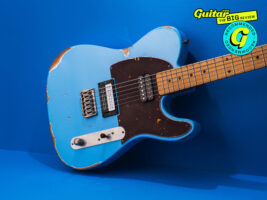
LsL Instruments Baribone review: custom baritone T-type finds the balance between vintage and modern
$3,999, lslinstruments.com
What a time to be reviewing an LsL guitar. Yes, for the last few weeks this Baribone has been awkwardly slotted into my guitar rack next to a few Fenders, no doubt feeling like it had wandered into a bar in the wrong part of town, the part where the honky-tonk piano crashes to a stop when the saloon doors swing open, and all the patrons tentatively reach for their lawyers’ email addresses.
READ MORE: Gretsch Electromatic Jet Baritone review: more long-scale chaos from Gretsch
Thankfully, for guitar reviewers who are running out of ways of describing the elephant in the room without wanting to waste a lot of word count reminding people about current events, the instrument we have here is mercifully separated from the current hurley-burley, though it is extremely on brand for 2026.
Image: Adam Gasson
What is it?
So what’s different about today’s guitar? Well, it’s baritone for starters, with custom appointments that make it pretty far what even the Fender Custom Shop might make you unless you were prepared to remortgage the house and have a nice long chat with a Master Builder.
The custom nature of the Baribone line means LsL is pretty flexible about what your final instrument looks like, but the core model pairs a T-type body paired with a 27.5” scale length.
That baritone scale is a good middle-ground, particularly for faster playing – the tension is still quite hefty at B-B, but the fret span isn’t so wide that it feels like a different instrument.
From here, custom appointments open up a pretty wide world of single-cut downtuned fun – you can keep it traditional with a bridge plate and single-coils, go full modern with dual humbuckers and exotic woods, or combine your own personal mix of modern and vintage specs.
The latter has been done here: its future owner intends it to be used for progressive metal while still looking like something designed in the 1950s. And, indeed, used very hard every day since the 1950s – so it’s a vintage-styled heavy relic from a distance, but take a closer look, and something far more aggressive rears its head, with hefty humbuckers and jumbo frets.
Image: Adam Gasson
Build quality
While it still polarises, artificial ageing has become a pretty commonplace thing in the guitar space. From Novos and Murphy Labs to Mexican Fenders… hell, even super affordable instruments can be found with aged finishes now (Harley Benton’s new range, for instance).
As anyone who has got up close with these cheaper guitars can attest, artificial wear and tear can look a little artless up close when done on a mass-production scale. Conversely, this guitar is a reminder of just how much of an art form ageing an instrument can be.
The finish wear, for instance, very much accentuates the three-dimensional nature of the lacquer, with satisfying, crackly checking and smears of damage that reveal sequential layers of colour, primer and wood.
The hardware ageing is subtle compared to the body’s, which is good to see from a comfort perspective (no one wants an actual rusty bridge), and a thin vintage-style finish will obviously take the brunt of genuine wear-and-tear. The look of the headstock really benefits from the ageing, too, with a really pleasing character added to the substantial bevels by the complex chipping.
Importantly, the effect is cohesive. An easy tell for rubbish relicing is a sort of mish-mash of damage, the obvious result of randomly throwing screwdrivers at the guitar for an afternoon, rather than a wear pattern with a more narrative aspect.
Everything flows together here, and feels verisimilitudinous (there’s one for your next Scrabble game) in where it lies – forearm wear smooths out the area where your forearm rests, the pick wear is where you’d pick, and also sort of clears the way for you with a little scoop in the bevel of the pickguard.
The only gripe I have with the ageing is the slightly inconsistent feel of the neck – some of the process has left that darker patch where my thumb rests below the seventh fret feeling just a tad rough. It’s subtle enough that it’ll likely smooth out after a couple of sweaty gigs, but maybe just one more pass of a micromesh pad might have given the same aesthetic effect without the slightly raw feeling on the pad of my thumb.
As for the rest of the actual build quality, it’s frankly faultless. The guitar presents as an extraordinarily complete instrument, with none of the little compromises of setup and alignment that factory guitars sometimes have to make. For this kind of cash, of course, you’d hope that it would be so – but it’s worth putting across just how neatly everything has been made and assembled here.
Image: Adam Gasson
Playability
Picking up the guitar and giving it an unplugged strum, it’s striking how lively it feels. The factory setup and strings make for quite substantial tension in B standard – and that translates to extra twang and resonance from the lightweight, lightly-finished body. To channel Nigel Tufnel for a moment – even unplugged, it sustains for absolutely bloody ages when you ring out a big chord.
The neck profile is a custom C profile designed by LsL master builder Chris Fleming – and aside from the aforementioned rough patch it’s a very pleasing profile. Longer scale length aside, it still feels like a comfortable vintage Tele-style neck, particularly thanks to the 1.65” nut. Aforementioned rough spot aside, the texture of most of the neck is lovely and smooth – here the phrase “played-in” means that you’re never running up against any sticky gloss that’ll slow you down.
The jumbo frets here are mirror-smooth and, at first, distractingly massive – the vintage look makes me instinctively expect frets that aren’t railway-sleeper chunky, but, that cognitive dissonance quickly melts away upon actually playing the thing. The 12” radius helps things feel extremely glassy – not that I’m doing much bending on it, mind, thanks to that higher tension, but leads are a breeze and wide-open chords have a chewy, satisfying feel thanks to the extra space underneath the string.
At the right hand, the hipshot hardtail bridge is one of the best options for a no-nonsense string-through hardtail, with its little ramp for comfy palm-muting, and solidly made saddles that don’t drift downwards or rattle. Like a more traditional string-through Telecaster bridge, it makes for a pretty snappy feeling – but with a lot more comfort when it comes to heavier playing.
Image: Adam Gasson
Sounds
Plugging in, the first thing I notice is that the Bare Knuckle Impulse that’s in the bridge position sounds absolutely killer. This is a signature design for Josh Smith from Northlane, and it’s voiced specifically for heavy baritone tones. It makes good on that promise, smartly cutting enough low-end to keep things clear and tight rather than flabby, but by no means does it let go of any impact. It’s a little like having an always-on tightening booster, something like an EQD Arrows, which, if you’ve ever used you’ll know just kind of makes most dirt pedals sound better.
The neck pickup is an in-house LsL humbucker. It’s fairly hot, but not to the point of overwhelming the signal, and in tunings like this, you don’t want to have something with too much power in the neck. Tonally it’s a little more of a classic humbucker, although most things are when compared to huge quad-bladed things like the Impulse. Regardless, it provides a nice contrast – a refined Japanese chef’s knife next to the sharp-but-brutal two-handed longsword of the bridge pickup – allowing for a more dynamic experience once you get that pickup switch in play.
Both are, of course, made nice and lively by the generally resonant character of the guitar – and while you can argue about psychosomatic transferral of tonewood characteristics through high-gain gear all you like, what you can’t argue with is the feel of the thing springing back in your hands and against your body as you strum it.
Overall, my time with this Baribone was pretty excellent, and I was (unsurprisingly) extremely sad to pack it up and send it on to its owner.
What I find exciting about baritones, too, comes across very strongly in the Baribone, resonantly and articulately projecting the huge presence of a downtuned instrument.
For heavy music, I can appreciate the ultra-thin shreddy necks and heel access down to the 22nd fret, but for my purposes the ergonomics of a Fender-style construction, replete with a vintage neck profile and nice big square heel, never provided a barrier.
Image: Adam Gasson
Should I buy one?
Thinking about it, that term “Fender-style” is a lot more loaded with potential legal ramifications than it was a few months ago, isn’t it? And it’s fair to say that lots more people will recognise the name LsL Instruments than they might have either.
For transparency’s sake, I should note that this review was arranged before the brand became the focal point of a legal firestorm, but it’s tricky to untangle it from the wider notoriety here in September 2026.
That being said, it’s nice to be able to check out something like the Baribone in the shadow of what else is going on and appraise why people might want a guitar from LsL, beyond social media cheerleading.
Because obviously, there are bits of Fender in this guitar’s DNA, but it melds that with a bunch of stuff that you simply cannot get from a production Fender guitar right now. A USA-made hybrid vintage/modern T-type baritone may not be a mass-market instrument, but it’s still a very cool thing that would not exist without smaller builders like this.
With that out of the way: should you buy an LsL Baribone? Well, if you’re spending this much money on a guitar, I’d hope you’d be certain enough in your intentions that a single paragraph of a single review wouldn’t be the final thing to tip the balance – but, to be just a data point in your decision matrix anyhow: you should.
Image: Adam Gasson
LSL Baribone alternatives
There are a good few other baritone instruments in this price range, but they tend to err on the side of more vintage-y or at least less heavy in their application. Novo makes a baritone version of the Serus J ($4,499), which is a similarly high-end custom with more of an offset vibe if that’s your thing. There’s also the Duesenberg Julietta Baritone ($2,999), a weirder unique thing with an undeniable eye-catching presence.
In the more explicitly metal world, ESP’s high-end offerings include some hefty seven-string baritones with somewhat T-style appointments, although more in the Jim Root tradition than the Roy Nichols one. Gibson has also just announced a ($2,499) bari version of its hard-rockin’ Victory model, too – it’s a cool thing for the 80s-inclined. And at around 1/10th of the price, there’s also something like the Squier Classic Vibe Baritone Telecaster ($549.99) and Gretsch Electromatic Jet Baritone ($549) if you’ve read this review and started to salivate at the idea of a single-cut baritone but are currently not in a position to drop $4,000 on an instrument.
The post LsL Instruments Baribone review: custom baritone T-type finds the balance between vintage and modern appeared first on Guitar.com | All Things Guitar.
Source: www.guitar-bass.net