
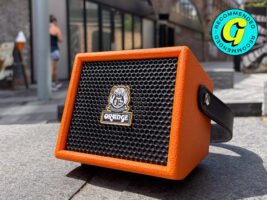
Orange Outlowd ES3 review: is Ed Sheeran’s signature amp the best compact acoustic combo out there?
$199/£149, orangeamps.com
Whatever you might think of Ed Sheeran’s music – and the comments on our Instagram posts would imply that certain sections of the Guitar.com community are not exactly overwhelming in their affection for the ginger prince – you can’t deny that he’s a bona fide guitar guy.
READ MORE: Martin 000-10E Retro review: “it authentically distils everything that’s great about 000 guitars”
This is an artist who has taken the ‘singer with an acoustic and a loop pedal’ concept and turned that into sitting just behind Beyoncé in the all-time album sales chart, while also being the third biggest-grossing touring act of the 21st century.
He’s also a guy who loves guitars so much he started his own guitar brand, Sheeran by Lowden, in 2019. The sense that Sheeran really cares about this stuff has only been enhanced by him adding his own looper brand to the stable a few years later, not to mention a PRS signature baritone.
Ed Sheeran with the Orange Outlowd ES3 amplifiers. Image: Mitch Lowe
The missing piece of the puzzle then was an amp. For someone who cut his teeth busking, the ability to amplify what he was doing with that loop pedal must have been so important, and so it’s a surprise it’s taken this long to arrive… but the real surprise is that he’s done it with Orange.
Because while literally nobody with ears can deny that Orange make superlative guitar amps for almost any style and budget, one thing the British brand hasn’t got any pedigree for – unlike the likes of Marshall, Fender, Laney etc – is making amps for acoustic guitars.
All of which makes the Outlowd – a series of three amps with the same fundamental DNA but different use cases – one of the most interesting and important new amp launches of the year. The less said about the name, the better, though.
Orange Outlowd ES3 – what is it?
The ES3 is the smallest Outlowd in the range, and it has a narrower remit than the bigger brothers in the family. Whereas the 100 and 60-watt versions are two-channel guitar and vocal amplifiers with a variety of inputs and outputs to make it at home as both stage monitor and performing tool, the ES3 keeps things simple. This is a three-watt hybrid acoustic amplifier and Bluetooth speaker, and that’s it.
Simplicity is the order of the day when it comes to this amp, and let’s face it, Orange in general – if you’ve ever found yourself struggling to get to grips with the functionality of one of the brand’s creations, that’s probably a you issue.
In keeping with that, then, the ES3 keeps things incredibly straightforward on the control side of things with knobs for just volume, tone and spring reverb, plus a button to activate Bluetooth pairing. That’s it!
Image: Mitch Lowe
Orange Outlowd ES3 – build quality and usability
If there’s one thing that Orange amps tend to have in common, beyond the colourful tolex of course, it’s that they are built in a manner that leads you to believe that should armageddon make its long overdue appearance, you could shelter from a nuclear firestorm behind one and come away with nothing more worrisome than a light sun tan.
The ES3 absolutely fits into that lineage, with its angled wooden cabinet not just expertly covered, but feeling incredibly rugged and well-built. It’s the sort of unfussily excellent build quality that leads you to wonder just how tall a building you could launch this thing off and still get a sound out of it.
You probably shouldn’t do that, however, because as with so many Orange amps, that reassuringly robust build comes at a cost. Despite being smaller than a six-pack, this thing tips the scales at a hefty 1.4kg (3.1lbs) – thank goodness for that soft and generous leather carry handle, eh?
As mentioned, the amp is intentionally stripped back and simple; you have just one input for your guitar, mini-rotary controls for volume, tone and the level of onboard reverb, and then a shiny silver button that you use to pair it to your phone for audio purposes.
Now, remember a few paragraphs ago when I said that anyone who struggled to get to grips with an Orange amp’s functionality was probably the one with the problem? Well, I’m going to tell on myself here and say that for a good 30 seconds after sliding the ES3 out of its lovely plush box, I pawed at the silver Bluetooth pairing button wondering why the amp wasn’t turning on and wondering if it was out of battery.
Image: Press
If you look closely, you’ll see that the power is actually activated by a notched switch on the volume pot – this is probably crushingly obvious to you, but for the sake of fellow morons like myself, I thought this was worth mentioning.
Orange’s ‘pics only’ approach to control labelling is in full effect here, and while anyone with eyes can see that it looks way cooler than boring old text, maybe it does have a drawback. There is perhaps an argument that given the ES3’s target audience of relative newcomers to the guitar amp world, it’s not exactly intuitive to have things like ‘reverb’ and ‘tone’ represented with what are effectively cool squiggles. Obviously, it’s very easy to work out what these things do in short order, but it does add a bit of friction for new users.
Otherwise, it really does feel every bit a very professional bit of kit, despite its size and price. The chunky rubber feet on the bottom make it stable and secure, the metal and fabric grille cloth means you can chuck it in a bag or case without worrying about the speaker being damaged – it’s rock solid.
Image: Press
Orange Outlowd ES3 – sounds
The elephant in the room with a tiny acoustic amp like this is well… does this really need to exist? An acoustic guitar, by its very nature, is pretty good at amplifying itself, after all… most acoustic players I know have amps primarily for live use where they also double as vocal amplification.
The ES3’s size and functionality obviously make it not best suited to all but the smallest performance settings, so what does it actually offer? Well, for starters we have to consider the cast of characters involved here.
Ed Sheeran is, of course, a musician for whom a dry acoustic guitar signal is very rarely the vehicle for his artistry, and you don’t have to go to many open-mics, cafe shows and other scenarios to see that effects are becoming increasingly common aspects of acoustic guitar musicianship.
With that in mind, having a small and portable amp that you can use to either practice at home with your full rig, or to add some effected sound for busking or smaller gigs has real utility.
Then there’s the fact that Orange amp design guru Adrian Emsley is a bona fide mutton-chopped amp design genius – one of the very few left in a world that seems to be moving away from the magic of real amps.
While most modern digital practice amps will have an acoustic mode that effectively offers a flat response akin to a portable PA, plugging a Martin 000 into the ES3 is a reminder of how different the experience is when you have someone who knows what they’re doing tuning every aspect of the amp to enhance and accentuate the sound of an acoustic guitar.
Image: Press
The four-inch speaker sounds full, rich and dynamic, accentuating the overall sound of the acoustic in the room rather than outright replacing it. With the tone control in the middle of its travel, you get a tone that has surprisingly punchy and enjoyable mids, while fingerstyle excursions demonstrate that even the high notes sound less thin and ‘string-y’ than you often get putting an acoustic through a practice amp.
There’s not a huge amount of bass response to be had here – after all, this lacks the passive reactors we see on other FRFR cabs – but it does a fine job and doesn’t sound too muddy.
The tone control itself is quite powerful, and sweeping it too far either way quickly makes the sound unappealing, but that’s not necessarily a bad thing. I found the power of this control useful for taming some of the boominess of a Guild dreadnought I also tried, or adding some enhanced midrange to a Gretsch parlor I converted to a rubber bridge guitar.
The real star of the show is the hall-like reverb, which adds a wonderfully produced sheen to basic strumming that really makes you appreciate the value of something like this even if you aren’t using loads of effects. If you are, however, it handles the likes of delay, chorus and even some granular stuff with aplomb – things never get too mushy.
As a Bluetooth speaker it sounds good, though the lack of independent guitar volume control is a little annoying here. You can control the music volume from your device, but turning up the master volume will also make the music louder, so if you’re playing to a backing track, you’ll want to make sure you’ve got your guitar volume sorted before you start getting your levels right, as any tweak to one will mean a tweak to the other.
In terms of music volume, it has plenty of projection and the ability to fill a decent-sized living room – it’s a little boxy and not the most bass-heavy sound ever, and it starts to get a little fuzzy at the upper reaches of the volume control, however, so be warned.
Image: Press
Orange Outlowd ES3 – should I buy one?
If you’re an exclusively home-based acoustic player, it might be hard to justify dropping nearly $200 on this – though I was pretty startled by how much more I enjoyed the sound of my acoustic at home plugged in with a bit of reverb. It really elevated the whole thing.
If you’re an acoustic player who does use loopers and effects in their sound, or play smaller gigs and busking shows where you just need something to give your guitar a bit of push and polish, this is an impressively designed and great-sounding option.
Orange Outlowd ES3 – alternatives
Blackstar’s Fly 3 Acoustic ($99.99/£89.99) is another small acoustic amp that prioritises ease of use and sounds great – especially when you pair it with its stereo cab. The Positive Grid Spark Mini ($199/£171) is a solid all-rounder that offers both electric and acoustic sounds, while Fender’s Acoustasonic 15 ($169/£129) is a solid small option, but it’s AC-power only.
The post Orange Outlowd ES3 review: is Ed Sheeran’s signature amp the best compact acoustic combo out there? appeared first on Guitar.com | All Things Guitar.
Source: www.guitar-bass.net