Positive Grid Spark Pedal review: The Spark ecosystem welcomes another box of tricks
It’s not an exaggeration to say that Positive Grid’s Spark completely redrew the guitar amp map when it burst onto the scene in 2019. Bringing studio-ready tones to the fingertips of guitarists everywhere was the mission, and what a successful ride it has been. The brand has gone from strength to strength in the years that followed, with the Spark now a family of amps that run the gamut from headphones to portable PA systems. Now, however, they’re taking a left turn into the speakerless world of pedals.
READ MORE: Positive Grid Reactor review: does your guitar amp really need an AI chatbot?
On paper, it seems like a very sensible move – pedalboard amps are increasingly popular, both for live use and for playing at home, and so having something compact that puts all the great sounds and ease of use of the amp into a smaller form factor is surely onto a winner.
At least, that’s what we’re all hoping anyway – trying to be both a practice amp, live solution and recording option in one is a lot of hats to wear, we’ll see if any fall off along the way…
What is it?
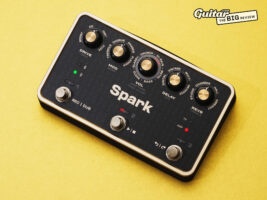
It won’t surprise people to learn that the Spark Pedal effectively distills the important bit from its amp brethren into a 6×4” floor unit. Now, it’s worth noting that the tech in here is the latest hotness – it uses PG’s HD Tone engine, the same architecture found in the latest Spark 2 amp.
Like its sibling, it comes loaded with 33 high-quality amp models and 43 effects as standard, and crucially that also means you get access to over 100,000 community-created presets courtesy of the hugely useful ToneCloud setup. If you’re a long-time Spark-user that has spent endless hours crafting perfect tones, fear not. You can easily load your saved presets from other Spark products and take them with you on the go. As with the other Sparks, it offers a relatively compact but useful array of bass and acoustic options for extra utility here too.
Sensibly for a floor-based option aimed at live players, it has the facility to be used purely as an effects unit – if you want to bypass the onboard amps, you can – and simply use it as a compact but powerful sound box.
The concessions to streamline its live use don’t stop there either – as with most Sparks, the Pedal has a built-in rechargeable battery, meaning that you won’t have to worry about plugging it into the mains or your PSU and in fact, you can’t – but more on that later. The battery life is promised to be up to seven hours, which is pretty impressive.
On the top you’ll find five chunky rotary knobs for on-the-fly tweaking, plus a trio of multi-function footswitches, while round the back you’ll find the upgraded I/O options that really set out the stall for this being a live tool. In addition to the usual mono input jack, headphone and USB-C output for silent practice and direct recording, you’ll find stereo outputs, an expression pedal socket, and in a first for a Spark product, MIDI in and out as well. Of course, being a Spark you’ll also need to hook this thing up to bluetooth to use the companion app, which is rather essential.
Image: Adam Gasson
Usability and Build Quality
The concern with any multi-effects that doesn’t have a a screen is that all the useful functionality is going to be hidden in the companion app, and nobody really wants to be whipping their phone out mid-gig do they?
Thankfully, while the Spark app remains a standard setter for both its ease of use and consistent and straightforward connectivity in this sector, there’s plenty you can do on the pedal itself once you spend a little time familiarising yourself with the fundamentals.
The three foot switches are home to up to six presets across two banks. Editing them and saving them using the pedal itself is satisfyingly straightforward. Select the preset you want to modify, do your thing, then press and hold the foot switch to save. No 20-page guide, secret handshake, or ritual sacrifice is needed here – it’s all rather intuitive.
The multifunctional volume knob in the center is responsible for switching between the two operating modes. In FX mode, the knobs control drive type, modulation, delay and reverb. Click that centre knob and the color coded LED light will indicate you are now in Amp mode. This is where you sculpt gain, bass, middle and treble, just like a real amp. Hold the centre knob down and you will activate the basic but welcome built-in tuner.
The built-in 60-second looper is as uncomplicated as one gets. Pressing pedals one and two together activates Looper mode. Recording/overdubbing, play/stop, and undo/redo functions are all handily activated with a footswitch each. If you can count to four, you’re golden here.
It’s an undersold part of the Positive Grid experience that they clearly put a lot of thought into the physical usability of their devices as well as the app-based stuff, and that’s true again here. It would have been very easy to make this pedal look like a Boeing cockpit, but with some simple and intuitive paring back, they’ve kept all the features you’d need mid-show accessible.
Image: Adam Gasson
That said, the Spark app is absolutely crucial to the experience here. Constructing signal chains and exploring ToneCloud is a total blast. However, on-the-fly adjustments in a live scenario from the pedal alone proved much more difficult. For example, you stomp into your meticulously crafted solo channel but the volume isn’t quite there? Reaching down to turn the main volume knob will sort that out. However, it turns up the volume across all your other channels too, like a master volume knob would. Not ideal.
The app isn’t a bonus feature here, it’s still the star of the show, and a necessary companion when you’re sculpting your sounds. I ended up having my iPhone in a cradle attached to the mic stand during rehearsals, but that’s really not what you wanna be doing during a performance is it?
There are some other compromises here to get it out at the very impressive $199 price point. Compared to the rugged unflapability of a Boss pedal, the Spark Pedal’s aluminium chassis and one-piece silicone cover are perfectly serviceable, but I would wonder how well that cover is going to last after a few months of being knocked about on venue floors and on street corners.
And knock it about you probably will. While the fact that this weighs just 0.58kg is very impressive – that’s significantly less than a Nano Cortex for example – there is a tradeoff there. It’s so lightweight, it’s quite easy for a stray foot to knock it away from where you want it to be – while the sturdy rubber footing stops it flying out into the audience, again I wonder how robust that would be long term.
The footswitches also don’t feel as premium as you’d like – they have resistance and lack that satisfying “click” of other stomp boxes. I’d probably think twice before stamping down on them with gay abandon in a pair of Docs, put it that way.
The pedal’s built-in battery is again both a boon and a potential issue. On the one hand, if you were a busker or were using it as your entire rig, the ability to run it without plugging into anything is potentially the killer app: especially with that seven-hour battery life.
On the flipside, if you wanted to use this alongside other pedals, or as a semi-permanent part of your pedalboard, the fact that it only runs on battery power – you can’t have it plugged into a pedal power supply or any other pass-through adapter – could be a real issue. Do you really want the hassle of having to make sure that one pedal is charged up before every gig? And then there’s the potential of battery degradation in the future that we’re all more than familiar at this point – seven hours at launch is great, but how long will that be in two years of heavy use, or five? This is obviously a problem with any guitar device with a lithium-ion battery in it, but it could be extra problematic for futureproofing with a device that’s designed to be used live without a net.
Image: Adam Gasson
Sounds
The excellent sound produced by Positive Grid products is no secret in 2026 – if you’ve enjoyed the broad array of amps and effects in any other Spark product to date, expect the same here.
The consumer-friendliness of the entire ecosystem should also be applauded, and there’s a real sense of community here among the ToneCloud regulars. The variety of tonal possibilities never seems to end, and I found myself getting lost for hours just… playing. Headphones on, Metallica backing tracks, completely butchering album upon album’s worth of Kirk Hammett solos. Heaven. It’s also a great tool if you’re in a covers band – with so many song-alike and artist-alike tones in the ToneCloud, dialling in the sound you need is an absolute doddle.
If you’re after the crystalline Vox-adjacent tones of a Matchless or the punishing brutality of a cranked Peavey 5150, the Spark’s HD models do a fine job of recreating the whole gamut of amp types with a faithfulness that belies the Spark Pedal’s humble size – whether you’re running direct into a powered cab, a PA system or just going through headphones. That’s true with drop tunings, heavy riffing, almost anything that might cause a lesser modeller to get a bit glitchy and messy. This isn’t a level of sonic fidelity that can go toe-to-toe with the likes of Neural or Kemper, but remember that this is considerably cheaper than even some of the more affordable amp and effects units out there.
The effects are equally impressive, with the drives sounding thick and chewy, the fuzzes sputtering in the appropriate way, and the reverbs and delays sounding suitably cavernous. Again, this isn’t a HX Stomp, but that’s double the price!
If you don’t fancy that hassle of building a Spark signal chain yourself, the Spark AI tone-prompting feature has been updated to version 2.0 now, and while it’s certainly not foolproof, it’s clear that PG has learned some lessons from the Reactor amp and the results you get are more or less very usable. It’s not essential, but it’s a handy one to have if you’re trying to sketch out song ideas or find inspiration in a hurry.
Image: Adam Gasson
Should I buy one?
At $199, the Spark Pedal represents a superb amount of functionality and versatility in a small, intelligently designed package. The combination of portability, solid tones, app features and straightforward usability makes this the perfect unit for buskers, jamming musicians, and bedroom players alike.
There are definitely a few drawbacks to consider if you’re a gigging musician looking for a credible live option however. While you can get by with most everyday needs with the on-pedal controls, the thought of having a mid-gig crisis that requires whipping a phone out and trying to pair with your pedal via Bluetooth fills me with a special kind of dread. I’m not wholly convinced by the build quality and long-term battery life either.
Also, if I was to indulge myself slightly, I would love to have a powered speaker output included, allowing the Spark Pedal to power a cab directly. Blackstar’s Amped pedal range has shown just how appealing a true “all-in-one” pedal-amp format can be.
Of course, adding a power-amp stage would demand a totally different power architecture, and likely ruin the Spark’s rechargeable portability, so perhaps I’m asking a Swiss Army knife to pack a chainsaw. Still, it would be dreamy.
Perhaps it’s inevitable that a product aiming to do so much at this price point is going to have some compromises here and there, but this is still a very impressive and fun to use product that ticks a lot of boxes.
If you’re happy to tinker with tones on your phone, and want the flexibility of a unit that can be at home both in the bedroom, the practice room or the street corner, this is a very compelling option. It doesn’t reinvent the wheel, but the Spark is mature technology at this point, instead, it’s trying to build on what it did so well half a decade ago – removing friction from the guitar playing experience.
Alternatives
This space in the market is home to some other excellent and affordable alternatives. Boss’s GX-1 ($229.99/£219) takes its tone DNA straight out of the flagship GX-100, and has a screen and a wah pedal built-in – I’m not convinced the amp models sound as good as the Spark’s though. Blackstar’s Amped 2 is a little more expensive and doesn’t have as many onboard sounds (£391), but the tones are legit and it really packs a punch, and can power a cab directly. The Line 6 POD Express ($179.99/£149) is even more compact than the Spark Pedal, and comes directly from the HX family of processors, but it’s got a limited palette of sounds comparatively.
The post Positive Grid Spark Pedal review: The Spark ecosystem welcomes another box of tricks appeared first on Guitar.com | All Things Guitar.
Source: www.guitar-bass.net