Source Audio Pathways review: “a pedal that sits comfortably between the worlds of modernity and tradition”
$349/£349, sourceaudio.com
Everybody loves a good reverb pedal, and right now it feels like we’re living through a golden age of ambient effects. Whether you’re after a subtle plate, a cavernous hall, or some otherworldly wash of galactic ambience, there has never been a shortage of options. If anything, today’s market is almost spoiled for choice.
READ MORE: Attic Audio Putty review – will this ultra-mouldable preamp give you The Edge?
That said, not every player is chasing increasingly expansive soundscapes. For many guitarists, the magic still lies in the tried and true sounds of vintage spring reverb and pulsing tube tremolo. It’s a classic combination that has shaped countless recordings for decades, and one that continues to inspire players today.
Enter the Source Audio Pathways. On paper, it promises to bring those timeless reverb and tremolo sounds into the modern era, combining both effects into a single compact enclosure. Of course, whenever two effects share the same pedal, there’s always the question of compromise. Does combining them result in the best of both worlds, or does convenience come at the expense of performance?
What is it?
Source Audio’s description of the Pathways is pretty straightforward. At its core, it’s built around one of the most beloved effect pairings in guitar history: reverb and tremolo. Given Source Audio’s reputation for creating some wonderfully esoteric soundscaping machines, you might be expecting me to explain how this pedal takes these two classics and gets weird, but no – this is very much the peanut butter and jelly of guitar effects, presented without any gimmickry.
That’s not to say this is lacking in options sonically. The Pathways packs seven onboard reverb and echo algorithms: Slap, Echo, Spring, Tank, Room, Plate, and Hall. Those are paired with three tremolo voices: Harm, Opto, and Bias, along with three selectable note subdivision options. The result is a broad range of sounds that can cover everything from old school surf and vintage Americana to the kind of cavernous ambience that makes you immediately feel like a Slowdive record.
Image: Press
Build quality and usability
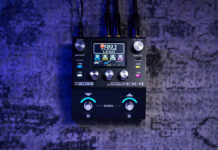
Physically, the Pathways is a noticeable departure from the larger enclosures used for pedals like the Collider and Dimensions. Instead, it shares a footprint much closer to the Source Audio Artifakt. In other words, it’s smaller than what many of us have come to expect from Source Audio. Good news for anyone whose pedalboard is already one new purchase away from violating local zoning regulations.
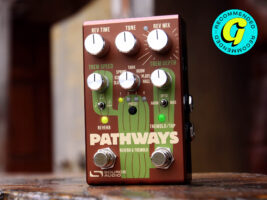
When it comes to controls, Source Audio has continued its recent trend of keeping things refreshingly simple. The pedal features six knobs, with the top row dedicated to reverb duties: Reverb Time, Tone, and Mix. The bottom row handles tremolo controls, including Speed and Depth, while the center knob in the second row serves as the mode selector and will likely be the control you’ll interact with most often.
Of course, this is still a Source Audio pedal, which means there’s considerably more happening beneath the surface than the control layout initially suggests. MIDI support, USB-C connectivity, and integration with the Neuro 3 app also potentially expand the pedal’s capabilities dramatically – offering deeper editing, preset management, and a level of customization that power users will undoubtedly appreciate. And speaking of preset management, you have four onboard presets to switch between sounds.
Image: Press
Sounds
To really see what the Pathways was capable of, I reached for what felt like the obvious choice, a Jazzmaster. After all, few guitars are better equipped to cover the sonic ground this pedal is aiming for, from drip-soaked surf rock to the kind of lush ambient soundscapes that make you want to spend an afternoon pretending you’re in Sigur Rós.
I wanted an amp that didn’t have any onboard reverb or tremolo to see how it enhanced the overall package, so I plugged into a Milkman Beekeeper combo – there was truly nowhere for the Pathways to hide. Every bit of ambience and modulation coming through the speaker was entirely its own doing.
It didn’t take long for the Tank setting to win me over. It’s wonderfully bouncy and absolutely dripping with character, delivering an immersive warmth that immediately felt familiar. More importantly, it captures that vintage spring reverb magic without feeling like a sterile recreation of the past. Each chord rang out with the kind of wet articulation that instantly transported me back to the classic outboard tanks and amp reverbs of the 1960s. There’s a depth and dimensionality here that reminds you exactly why guitarists fell in love with spring reverb in the first place.
The rest of the reverb offerings are equally impressive in their own right. In particular, I found myself repeatedly gravitating toward the Hall setting and its gloriously indulgent wall-of-sound ambience. It’s the kind of reverb that practically asks you to play slow chords and make questionable life decisions. Likewise, if your tastes lean more toward traditional Room or Plate reverbs, there’s a level of attention to detail here that makes each algorithm feel thoughtfully voiced rather than simply included to pad out a spec sheet. Then again, when it comes to reverb, did we really expect anything less from Source Audio?
Image: Press
Admittedly, I’m not the world’s biggest tremolo enthusiast, which meant that side of the Pathways had a tougher job winning me over than the reverb section did. That’s not to say the tremolo sounds aren’t good. Quite the opposite, actually. While all three voices are more than serviceable, I found myself spending most of my time with the Bias mode. There’s something about the way it adds movement and depth without overwhelming the front end of your signal. Each note carries a warm, pulsating warble that feels far more organic than I expected, making it both rewarding and surprisingly addictive to play through.
However, it’s the interaction between the reverb and tremolo engines that ultimately becomes the Pathways’ biggest selling point. Combined, they create some genuinely gorgeous textures that can move effortlessly between dream pop soundscapes worthy of Cocteau Twins and the subtle surf-inspired pulse of Dick Dale. A feat that I thought nearly impossible outside big-box offerings like Eventide’s H90.
Oddly, the only shortcoming I found with this pedal was the Neuro 3 app integration. While it’s one of the best apps I’ve encountered in terms of technological integration and implementation, with Pathways I never really gave it much thought and would posit that most people who purchase this pedal are still best served by what it’s immediately capable of. In some ways I can’t help but wonder if that will come as a detriment to the Neuro 3 app, or if people will completely forget that it’s there.
Should I buy one?
The Pathways feels like Source Audio has managed to thread a very difficult needle. It captures the tonal character that made vintage reverbs and tremolos so beloved in the first place while embracing the flexibility and convenience that modern players have come to expect.
Is it perfect? No. While the Neuro 3 app is genuinely powerful, I suspect a lot of players will spend most of their time enjoying the pedal straight out of the box rather than diving deep into its expanded functionality.
Likewise, if your primary goal is creating massive ambient soundscapes that could double as a film score, you’re probably better served by some of Source Audio’s more ambitious offerings, such as the Dimensions.
On the flip side, if you’re a diehard traditionalist looking for a near one-to-one recreation of the classic reverb and tremolo sounds of yesteryear, the Strymon Flint remains one of the category’s standard bearers thanks to its simplicity, feel, and remarkably authentic sounds.
The Pathways sits comfortably between the worlds of modernity and tradition. More importantly, it accomplishes all of this without feeling like a compromise. Whether you’re chasing surf rock drip, Americana warmth, dream pop textures, or ambient soundscapes, the Pathways feels equally at home. That’s not an easy balancing act to pull off, especially in a compact enclosure. But for anyone curious, it’s not only worth the financial investment, but it’s also worth the creative possibilities it begs you to explore.
Like this? Try these alternatives
Strymon’s Flint ($349/£329) is a wonderfully simple and great-sounding reverb/tremolo, and the V2 version adds MIDI control and the ability to store up to 300 presets. Robert Keeley’s Zoma ($229/£289) is the effects guru’s attempt to create a stripped-down and no-nonsense take on Fender amp-style trem and reverb, and it’s very good. Fender’s effects pedals don’t often get enough mention, but the Tre-Verb ($359/£219) is a very good stereo reverb and tremolo.
The post Source Audio Pathways review: “a pedal that sits comfortably between the worlds of modernity and tradition” appeared first on Guitar.com | All Things Guitar.
Source: www.guitar-bass.net