
This is why your guitar’s scale length actually matters
Scale length is one of those items on the spec sheet that I always saw, for many of my early years before I ever knew what it actually was or what it meant. I would hear terms like “Fender scale” or “Gibson scale” and politely smile and nod.
READ MORE: What actually happens when you adjust your guitar’s pickup heights?
There were so many differences between a Les Paul and a Telecaster that I never thought much of the scale, but it does have quite an effect on the playability of the models. In this article, we’ll explain what scale is and why it matters – and how you can use that to choose a guitar with the right scale for you.
What the number actually means
Scale length is the working length of the string, measured from the nut to the saddle. The simplest way to find it is to simply measure it. A 25.5-inch scale length has 25.5 inches of string free to vibrate on every course, and that’s all the number tells you on its own. Everything worth knowing comes from what it forces the rest of the instrument to do.
A lot of electric guitars you’ll pick up will sit in one of two camps. Leo Fender built the Telecaster and Stratocaster around 25.5 inches, and that became the standard for Fender and for the mountain of guitars built to copy them. Gibson went with 24.75 inches on the Les Paul, SG and ES-335. If you’re wondering why it is measured in inches instead of metric, its simply because Fender and Gibson were based in the US and the specs fell into that unit of measurement.
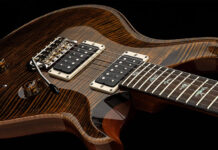
Three-quarters of an inch sounds like a rounding error, and as a measurement, it nearly is. A few builders split the difference on purpose. PRS landed on 25 inches, reaching for a bit of Fender’s tightness and a bit of Gibson’s give in the same neck. Other guitars exist outside the 25.5-24.75 thresholds. We’ll get to them later in the article.
Why a longer scale length guitar fights back
Bringing a string up to pitch takes a set amount of tension, and a longer string needs more of it to reach the same note at the same gauge. The relationship isn’t gentle, either. Tension climbs with the square of the scale length, so swapping a 24.75-inch guitar for a 25.5 with identical strings and tuning piles on roughly six per cent more tension across every string.
Six per cent doesn’t read like much, but your fretting hand will feel it. The longer Fender scale pushes back against your bends and snaps to pitch faster. It stays firm when you dig in. It’s a big part of why players coming off a Les Paul onto a Strat so often drop string gauge from 10s to 9s, just to get the old slack back. A shorter scale does the reverse. It’s looser and more forgiving, and bends come without a fight. Plenty of blues and rock players build their whole feel around that softer response.
What scale length does to your tone
Tension shapes the sound as much as the feel. A tighter string speaks with more clarity and top end. There’s more harmonic content sitting under the note, and the low end holds firmer, which is a chunk of that bright, almost piano-like attack baked into the classic Fender voice. A looser string leans harder on its fundamental and comes back warmer and rounder, with the highs pulled off the top. So crediting Gibson warmth entirely to mahogany and humbuckers leaves something out. The short scale is in there doing its share.
Fret spacing is the most visible effect. You cant just move a Fender neck .75 inches further into the body and have it work as a Gibson scale – the fret spacing is different. A longer scale stretches the frets apart, which keeps notes separated but asks more of your hand down near the nut. A shorter scale brings them in tighter, friendlier for small hands and fast chord work, though it can feel cramped once you’re past the body/neck joint.
Non-traditional scale-lengths
Step outside the Fender-versus-Gibson norms and builders start reaching for scale length on purpose. Short-scale guitars like the 24-inch Mustang and Jaguar, or the old Danelectros, play slinky and run a little dark, which is half of why indie and garage players love them. Basses follow the same logic. A 34-inch scale keeps a low E from going to mush, while 30-inch short-scale basses trade some of that tightness for warmth and an easier reach.
Baritones are usually defined as having a scale length of 27 inches or more. The whole point is to tune well below standard without the strings turning to wet noodles, since the extra length holds the tension together down in low drop tunings.
Fanned-fret guitars chase the same fix from another angle. Ralph Novak’s Novax designs run a longer scale under the bass strings and a shorter one under the trebles, with the frets angled so the geometry lines up. The low strings hold their tension and the high strings stay easy to bend. That was the idea behind fanned frets.
So, which scale is right for you? That’s not for me to say. My advice is always to get your hands on as many guitars as possible and see which ones feel and sound best to you. That’s why I love guitar stores where you can pick a guitar up and test it out. It allows you to know what you’re looking for when buying a guitar.
You might prefer the look of Fender guitar but the more compact dimensions of a Gibson – that’s what I realised, and it’s why I build Fender-style necks with 24.75-inch scales for my guitars. Warmoth and other aftermarket companies make these sorts of conversion necks as well if you’re set on the look of one body shape but prefer a different scale length.
Few players can tell the difference by looking at it, but the feel is undeniable. That’s why scale length is such an important part of any guitar equation.
The post This is why your guitar’s scale length actually matters appeared first on Guitar.com | All Things Guitar.
Source: www.guitar-bass.net