Yard Act’s Sam Shipstone on clichés, concision and how guitars returned to their core: “Great bands really find their style, and that’s the thing they sit on”
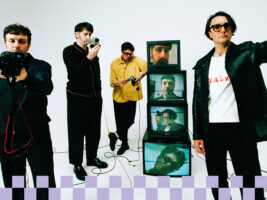
“We’re a rock band, what are we doing?” chuckles Sam Shipstone, telling Guitar.com about the collective realisation that Yard Act needed their own space. Surrounded by flight cases, old merchandise and various paraphernalia from their first two albums, we’re taking cover from the heatwave on the outskirts of Leeds at the band’s 18-month-old HQ.
It’s quite literally their baby; the office for the Dream Job’– to coin an old song title of theirs – and a territory that enables the type of impulsive, unbroken creativity that a young Shipstone craved.
READ MORE: “I’m totally a guitar guy” the OG Red Wiggle Murray Cook on Spinal Tap moments, 40s Martins and embracing his blues-rock soul
“20 years of dreaming about that, finally got three months of it!” he quips, finishing his guided tour of the room and preparing to dig into the nitty-gritty of how album three, You’re Gonna Need A Little Music, came into existence. “Even though we’ve been in this band for a little while, we’ve never afforded ourselves that privilege, and when you start in music, that’s the kind of life you really want: ‘I’m going to sit in a room for months and explore ideas.’ It’s a huge privilege, and that was not lost on us.”
Beforehand, Yard Act’s post-pandemic explosion and unrelenting touring resulted in two albums with sporadic processes, despite the post-punk cohesion of 2022’s debut The Overload and the entertaining but eccentric Where’s My Utopia? (2024). Simultaneously in the lineage of The Fall, LCD Soundsystem and Pulp, the band were soon headlining London’s Brixton Academy and Millennium Square in Leeds city centre.
Image: James Winstanley
You Can’t Park There, Mate
After the four spent plenty of time in other bands, this one bolted from the jump, visually mirrored by what you see in this storage unit-slash-rehearsal space. Between congas, music video props and a piano gifted by vocalist James Smith’s aunt, Shipstone carefully unearths his pedalboard – although he’s taken his guitars back home to Bradford. We also spot an oud he received as a birthday present. “I’ve definitely got more invested in music theory, and with a fretless instrument, you can go a lot further. It’s a bit trendy now, microtonal stuff…
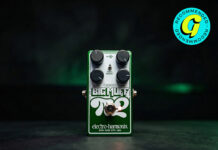
“My main boost is this Full-Drive 2, but when we’re recording, I use the RAT a lot, because I think this one’s got a thickness to it,” he continues. “The brights aren’t very punishing, and because I play with those [G&L] ASATs, you really want them to be strong, because that’s the character of that guitar, but you need to tame them a bit. So I settled for this boost, because it didn’t make the brights too crazy. But when we used the RAT, it was like, ‘This is the sound that you want, when you want a really distorted guitar.’”
He used the RAT on record for the funky, upper-cut riff of Fiction, which hundreds of fans heard for the first time in the car park of Leeds’ Brudenell Social Club at the second of two free gigs in May to launch this record. Missing from proceedings was their mascot-style car, The Rover, recently burnt to the ground, despite being a fixture of the car park and their storied pop-ups and residencies at the venue. Automobiles aside, this record feels like a reset, exemplified by Yard Act’s choice to debut the entire LP at those shows.
“Albums one and two we did on laptops, and album two specifically was really hard to try and conceive as a four-piece,” Shipstone explains. “It took a lot of work to translate how we’d recorded it to [live], whereas this record, these songs are already good to go. It made me think, imagine being The Rolling Stones, they’d literally play songs live and on record exactly the same way! Redeemer works really well. You’re Gonna Need A Little Music always gets the crowd jumping, even if they don’t know it, which is good.”
After demoing the album at their base, the group laid down the instrumentation at nearby studio The Nave before decamping to Los Angeles and the home of producer Justin Meldal-Johnsen for overdubs and vocal takes. Shipstone abstained from packing his guitars, having primarily relied on his trusty butterscotch blonde ASAT at Nave, but he couldn’t resist mucking around with Meldal-Johsen’s extensive collection.
“You see his own history reflected in the guitar choices,” Shipstone says. “He’s got a Nine Inch Nails and a Beck connection. I played a Silvertone 1448, a plucky mid-range guitar, and that feels like a Beck guitar to me. Justin had a really mint Stratocaster. I didn’t get the year, but it was beautiful. I’ve never really owned one before, and that was one where I thought, ‘Oh yeah, the bottom end of a Stratocaster, the balance of it, is really great.’”
Image: James Winstanley
Rein It In
You’re Gonna Need A Little Music reunites the guitar with the nucleus of Yard Act’s sound. Songs like Cherophobe Rock and Thrill Of The Chase tread far closer to The Overload than album two, where Shipstone took more of a back seat, because “if you’re writing on a tour bus, you’re not going to go to a guitar first,” he tells Guitar.com. “[Those] songs get quite a lot of life in them before a guitar’s ever been thought of being added, so then you’re really adding that guitar as an overdub rather than a core part of the structure.
“We’ve got certain Yard Act clichés,” he readily admits, “but I think we need to stay more on a style than we probably are.” Why? “Great bands really find their style, and that’s the thing they sit on. I think creativity is best when it’s strangled in a certain way, when the options are closed off. All creative people want to be doing something novel, [but] following that too much will make the spirit of who you are suffer a little bit. Sometimes we need to rein in stuff that’s gone a bit too far… where it just isn’t Yard Act, this is pastiche.”
That’s not to say You’re Gonna Need A Little Music isn’t exploratory. The title track’s pop-loving chorus lands like the sun peeking out from behind the clouds, while the riff in Fiction turns their jagged post-punk guitar lines into a football chant that shadows the chorus vocal hook (“Weezer do that a bit, don’t they?”). Despite a renewed emphasis on the guitar, there is a seat at the table for pop sensibilities that offset the peculiar structures in Redeemer and Empty Pledges; an exercise in appeasement, Shipstone reckons.
“In Greek mythology, sometimes you had two gods ruling the same sphere of human activity. With modern music, there’s the god that says, ‘You need to do something that your audience will like,’ and the other god: ‘Ignore your audience and do your own thing.’ Most people that just follow that [second] god that makes crap music… but if you just follow your audience, you’re just a slave to trends that’s going to make terrible, artistically compromised music. You’ve got to have both of those gods always honoured at once. English Teacher do that really well!”
This tangent aligns with what he told us in 2024 about serving what the song needs, which he candidly admits can generate tension in the process. “It’s tricky, because when you’re in your head in those arguments, the ‘greater thing’ is your notion of what that should be,” he says, currently sitting on the fence while Smith and bassist Ryan Needham debate whether The Overload will remain in the setlist. Crucially, though: “We do listen to each other. We’re definitely bigger than the sum of our parts in this.”
Image: James Winstanley
Post-Punk’s Latest Poster Boy
Individually, though, Shipstone’s admittance of Yard Act clichés arguably extend to his guitar playing, now honing in on the type of recognisable style that he values. “[Yard Act] definitely made me play in a different way,” he says, remembering after-school lessons on the Isle Of Man with Miss Dennett in Year Six.
“My dream, when we started this band, was to use gain and be done with it, and have a very naked, forward, spiky guitar sound. I think the guitar sound [has become] thin, lead-y, definitely wonky. Without being punk-aggressive, it needs to push out those notes hard.
“Sometimes I listen to post-punk playlists on Spotify, and there is a certain stylistic similarity,” he continues. “It’s often reverb-y, repeated staccato lines, and I think [my sound] is a little bit different. I don’t think it’s a sound that’s as strong as many other guitar players,” comes the caveat. But perhaps Shipstone – and Yard Act – are on their way to becoming the influential guitar gods that future rock bands will try to appease. “I’ll tell you what, I haven’t heard anybody copying it. Which might be because it’s not worth copying…”
Discussing inspiration from ‘lofi beats to study to’ playlists on YouTube for the fragmented chords on Janey Said, while Joy Division’s Love Will Tear Us Apart influenced Thrill Of The Chase, Shipstone has come a long way from the teenager hellbent on emulating Led Zeppelin’s Jimmy Page and mastering power chords. Every time he touches his six-string, it comes with a purpose, rather than mindless noodling or escapism.
“I think it’s just like adult life, you have a bit more responsibility,” he muses. “I’m not allowing myself to be distracted, it’s like, ‘Okay, I’ve got an hour, I’m going to do this.’” Visibly inspired by his newfound love of music theory, the learning curve – inside and out of Yard Act – will continue. “In the history of popular guitar music, most musicians shun music notation as a system. You don’t need it. But there’s a way that musical notation gives you a visual impression of chords and harmony that is a lot stronger than the guitar lets you see it.”
You’re Gonna Need A Little Music is out now via Island Records.
The post Yard Act’s Sam Shipstone on clichés, concision and how guitars returned to their core: “Great bands really find their style, and that’s the thing they sit on” appeared first on Guitar.com | All Things Guitar.
Source: www.guitar-bass.net