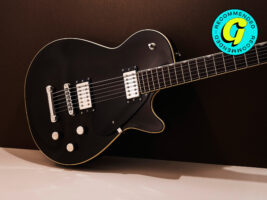
Gretsch G5260 Electromatic Jet Baritone review: more long-scale chaos from Gretsch
$549/£519, gretschguitars.com
By the end of this year, I’ll most likely have reviewed more baritone guitars than regular-scale instruments. There are a bunch of reasons that guitar culture is thoroughly embracing the whole baritone thing these days, but enough wrangling on about Loathe and Sleep Token has been done in these reviews alone to fill a nine-volume encyclopaedia. So, let’s take the fervent appetite for baritones as a given, and look at another of this year’s new heavy-focused Gretsch instruments: the Jet Baritone.
READ MORE: Do you really need a baritone? A complete guide to guitar scale length
Image: Adam Gasson
What is it?
The Jet Baritone is the sibling instrument to the CVT Baritone, which I reviewed a short while ago, and also absolutely bloody loved. That guitar was treading some new ground for Gretsch, in that it was utilising the niche, recently-revived Corvette body shape, and working with a 27” scale length. The Jet, on the other hand, is much more within Gretsch’s established wheelhouse of baritones – it follows the G5260 from a little while ago, the thing that arguably kicked off this whole accidental association between Gretsch and modern metal. Like that guitar, we’ve got the more vintage 29.75” scale here – just a quarter-inch short of a Bass VI.
So what’s different this time? Well, like with the CVT, Gretsch has abandoned its more vintage, restrained sonic palette – lest we forget that the Loathe-featuring demo video featured more pummelling downtuned riffs than you could shake a long-scale stick at, calling to attention a spec-sheet that’s more metal than a Slayer gig in an industrial blast furnace.
Both of the 2026 Gretsch baritones have launched with the new Twin Six humbuckers, full-bodied things that will handle heavy sounds a lot better than the vintage-output pickups more commonly found in Gretsches. There’s also a more neutral, flat stop-bar tailpiece, rather than the vintage-style V stop-bar, and we’ve got coil-splitting push-pulls controls for both pickups if that’s your thing.
The Jet shape is still quite classically Gretsch – dating back all the way to 1953 when the brand went “oh crap, everyone seems to be buying a hell of a lot of solidbody guitars these days” – but the aesthetic touches here bring it into a classy modern metal mould fairly seamlessly. It’s all nickel hardware and dark wood (I much prefer the Imperial Stain here to the Bristol Fog of the CVT) with nice cream binding that has the secondary effect of keeping the outline of the guitar present and readable when you invariably play it wearing a black t-shirt.
The only headscratcher is that the pickup rings are made of a slightly tinted clear plastic. It’s subtle and by no means ruins the look, but it smacks of “we had a few extra boxes of translucent magenta pickup rings lying about” more so than “this will be a cohesive addition to this guitar’s aesthetic”.
Image: Adam Gasson
Build quality and usability
The Jet, like its sibling guitar, is built in a way that belies its mid-level price tag – this thing feels very premium for something that costs £549. The electronics are high quality, with all-metal knobs and push-pull posts that give a reassuring clunk upon operation. The tuners are fairly prosaic sealed ones, but they’re more than functional and even with some silly tuning experiments, I never have the guitar drift out of tune.
Ergonomically, it’s an interesting thing – it takes, as you’d imagine, some getting used to, even for me, who plays a baritone basically every day. The 29.75” scale is well into Bass VI territory, which means quite a hefty span. The benefit is that a set of Bass VI strings and the right setup could absolutely see this thing stay stable down to double drop C# (IE, with the lowest string a casual 15 semitones lower than regular E standard).
As it stands, I stay between B standard and drop F, and have a perfectly pleasant time in doing so – tunings around B and A feel very taught indeed, while Drop F is obviously a bit slacker, the extra scale means the guitar handles it very well.
The body is relatively heavy, but what it loses in lightweight chuckability, it gains in feeling solid and well-balanced. The neck, which feels hilariously long (and makes standard-scale guitars feel like ukuleles after a week or so of testing) , always presents properly, and even if your arms and shoulders have to get used to a slightly wider stance. Not absurdly so, though – in converting the guitar to a baritone, the bridge has thankfully been moved quite far down the body, which means the string length isn’t totally off-centre.
The neck profile is a very middle-of-the-road thing, and while middle-of-the-road is seldom a ringing endorsement, it’s no bad thing here. Despite the metal focus, this is not a shred machine; it’s a riff machine. So there’s enough meat that it feels substantial and meaningful in your hands as you shift around power-chords, but it’s not thick enough that you’re just fighting it the whole time. It’s a little sticky and glossy, sure, but that’s really just its one concession to its price point – given its in the £550 range, I’d have no bones about taking some Scotch-Brite to it too if you wanted a more satin feel.
Image: Adam Gasson
Sounds
The Twin Sixes are, in my view, pretty damn good pickups. However, while the extra scale length here brings out a bit more punch in higher tunings like B and A standard, that extra punch highlights that the pickups are a little on the sludgy side, particularly if you venture down towards the Bass VI range. This is great for playing, well, sludge metal, but their meatier output is pretty full-spectrum, and compared to their performance in the CVT they get just a touch less controlled in the low end if you want tighter chugs.
While it’s perhaps unfair to compare this guitar to something almost ten times its price, I’m reminded of the LSL Baribone I recently looked at – specifically the Bareknuckle Impulse that was chosen for its bridge position. That was a pickup voiced for heavy-focused baritones, and you could really hear it – here, the limitations of a slightly more broadly-voiced thing become a little bit more apparent.
The good news is that you can split the Twin Sixes, and while that brings some extra noise, setups that seek that chuggier, brighter sound will invariably be using a gate anyway. The split-coil sounds here through high-gain are actually really engaging, with a super twangy, djenty feel that brings back some extra articulation – although this may be a little too far the other way for some.
Of course, these split-coil sounds are well-suited to clean and ambient sounds as well. They won’t win any awards for outstanding depth and clarity, but they do the job well enough. As with the CVT, they remain pretty full-sounding and loud even in split-coil mode, so they won’t do a true impression of something like a Fender Bass VI – but that’s likely not your use-case for a guitar like this. For ambient textures and clean intros, they’ll get you there.
Image: Adam Gasson
Should I buy one?
There’s clearly an audience for this kind of guitar, and I think Gretsch has absolutely delivered for them – the longer scale means it’s flexible from tight standard-baritone things all the way down to truly extreme tunings, with electronics that are more than ready to handle heavier sounds.
The build quality and general togetherness of the instrument would make it an easy recommendation anyway, but it helps that it’s also pretty unique in its space. Realistically, if you’re enamoured with the vibe and aesthetics and are looking for an instrument of this scale length, I’d heartily recommend – the sounds are great at the moment, and as the pickups are easily-swapped humbuckers, they could get even greater down the line.
Image: Adam Gasson
Alternatives
An obvious alternative is of course the CVT equivalent ($/£599.99) with much the same specs but a shorter scale of 27” and a double-cut body. For a more offset vibe but staying in the HH mode, Squier has just released the Paranormal Jazzmaster HH baritone ($/£479.99), and the Fender Player Fusion Jaguar Baritone ($1,299.99/£1,049).
If you’d rather a more vintage set of sounds but want the same long scale, there’s both the Fender Vintera III Early ‘60s and Classic Vibe Bass VIs ($1,499/£1,229 and $569.99/£509 respectively), or the Danelectro ‘56 Baritone ($599).
If you’ve dry-heaved every time you’ve read the word ‘vintage’ in this review, and you play in the kind of band that has a separate budget for sacrificial goats, there are plenty of more explicitly metal baritone options out there with a more minimal, sharper aesthetic – such as the ESP LTD M-201HT ($599).
The post Gretsch G5260 Electromatic Jet Baritone review: more long-scale chaos from Gretsch appeared first on Guitar.com | All Things Guitar.
Source: www.guitar-bass.net