How Fairlane Guitars built a brand beloved by some of the coolest artists on the planet
For many guitar makers, seeing their instruments being played alongside some of the most popular musicians on the planet – and in the hands of their own favourite players – is often an “end goal” kind of deal, or, within the first few years of the brand at least, not something to worry about.
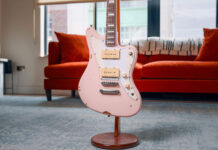
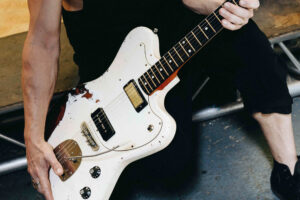
Despite the small size of the operation, and the fact the brand only started in 2020, the eye-catching offset shapes of Fairlane’s flagship models – the Zephyr and Cardinal – can be seen in the hands of everyone from Dallas Green to Beabadoobee, from Ed O’Brien to Daisy Spencer, and many more besides. The full artist roster is absolutely not to be sniffed at, and is notably all a result of word-of-mouth, thanks to the hard graft of the two people behind the brand.
The Fairlane Zephyr on the Guitar.com Cover. Image: Fiona Garden for Guitar.com
Fairlane guitars are made in a south east London workshop by Kevin Williams and Reuben Gotto, both of whom have been involved in the music industry in some way for their whole careers. Williams had always been interested in building – he made his first guitar with his dad when he was 16 – but his career across the music industry was more focused on playing, teching and tour management. He retrained in luthiery in the mid-2010s, and started working as the “main repair guy” for Monty’s Guitars.
“I really enjoyed that,” Williams recalls. “Matt [Gleeson, founder] was great to work for, really supportive and encouraging. I was making guitars at that time, and Matt told me, ‘This stuff is really good – you should be working for yourself.’ But it’s hard to take that plunge when you’re comfortable – guitar-building seemed like a side hustle, a hobby.” But when Covid hit – “usual story,” Williams sighs – Monty’s furloughed him, and the brand decided to leave London. “I didn’t have a job, didn’t know what to do – and that’s where Reuben comes in.”
Gotto was – and is still – on the road as a touring guitar tech for a laundry-list of notable artists. “I had been playing in bands in my early 20s, and then did that thing where you accidentally fall into teching for your mate’s band,” Gotto says, “And then the balance becomes more teching than playing. So I spent a good 15 years out with some amazing artists – I was on the road with Lana Del Rey when the pandemic hit.”
Image: Fiona Garden for Guitar.com
During lockdown, Williams and Gotto found themselves doing guitar repairs at home, working from their kitchen tables. There was no sign of their work slowing down, nor of normalcy returning any time soon – and so they moved their business into a dedicated workshop space.
“We had worked on a prototype, and developed it into something that was a little bit more our own,” Gotto explains. “When people came into the shop for setups and repairs, they’d ask, ‘What’s that weird, cool thing on the wall?’ That led to inquiries as to whether we’d make them for other people. We went deeper down that route – and because our clientele were coming through the workshop from our other lines of work, we were very lucky to have our guitar designs in front of a lot of cool people very quickly. That helped us hone them, and get opinions from people who we trusted to be honest with us.”
“It’s hard to take that plunge when you’re comfortable – guitar-building seemed like a side hustle, a hobby”
Best Of Both
The first prototype (the brand was originally named Providence Guitars) was an early version of the Cardinal – an alternative take on the Non-Reverse Firebird, a style of guitar that Williams had long been, in his words, “obsessed with”.
“As much as I love the Non-Reverse Firebird shape, it has a lot of issues,” he says. “It’s not like you can sit down and play that guitar. And it’s also not that comfortable when you’re stood up. So I wanted to see if we could address some of those issues, and that was the first one I made – even before we had started Fairlane.”
Image: Fiona Garden for Guitar.com
From there, the Cardinal’s set-neck design was reconfigured into a bolt-on – in the process, creating the Zephyr. “It was a challenge, that change,” Williams explains. “The neck approaches the body in a different way, and pushes things down into its own shape, its own whole thing really. So on top of the non-reverse Firebird thing, there’s some offset and Jazzmaster-inspired elements mixed in there too.”
A lot of Fairlane’s design philosophy involves crossing this bridge between Fullerton and Kalamazoo – alongside the hybridised offset looks of the Zephyr and Camino, the guitars mix the scale of a Fender with the fretboard radius of a Gibson. The pickup combinations – bespoke sets made in collaboration with Monty’s Guitars – often mix and match disparate styles in the bridge and neck positions.
Image: Fiona Garden for Guitar.com
“Some of it is knowing what works best for people live and in the studio,” Gotto explains. “We try to combine everything that we think is best about guitars. That’s the beauty of the history of them: you’ve got so much cool stuff to pick from and everything has its merits in different situations.”
“The initial decisions were made purely because we liked those things,” Williams adds. “Rather than trying to go, ‘I think this is what people will want.’ But, what we do see right now is that most people play Fender-style guitars more than they do Gibson-style guitars – that’s just where the world’s at. So people will be more used to that 25.5” scale length. So it was good to incorporate that, and still have the 12” radius for easier bends – it was all about mixing and matching until we found our formula.”
Thanks to the agility of a two-person operation, some playability decisions can be folded in straight away from custom orders. Gotto recalls one from Emily Rosenfeld, guitarist for Chappell Roan, Olivia Rodrigo and more, who visited the workshop and tested a bunch of guitars. “One thing she said was, that when she played open chords, she wanted her hand to be round further, so could we shave a little more off the bottom of the headstock. We tried it, it worked great, and now that’s just our design!”
“When people came into the shop they’d ask, ‘What’s that weird, cool thing on the wall?’”
Organic Produce
Fairlane’s guitars are offered in a range of relic’d options, and indeed many Fairlane players and artists have opted for at the very least lightly-aged guitars – and, in some cases, guitars that look like they’ve been played every day for 50 years. But for Gotto and Williams, ageing an instrument isn’t just about the cool factor. “Whether you like relic’ing or not, the fact that you pick it up and it feels like it has been played, that is what people want,” Williams says. “You can do it without relic’ing, that’s fine, but there’s a place for everything, I think, and I don’t know anyone who’d opt for a totally brand-new guitar rather than something that feels played-in.”
“If you’re playing guitar and it feels like an extension of you, something you’ve been playing for decades – it’s almost this passive thing,” Gotto adds. “Where you don’t even notice the instrument – you don’t feel every fret, you don’t have that gummy, glossy poly paint on the back of the neck. It’s nice to have something that just feels like an extension of you when you’re playing it. But there’s also this really organic experience, the enjoyment of texture and wood – there’s nothing wrong with liking that.”
Image: Fiona Garden for Guitar.com
Relic’d or not, the guitar in particular is obviously a great vector for this more organic experience, and both Gotto and Williams are clearly excited that the guitar as a whole has returned to have such a presence in the mainstream. “I think everyone chases that organic thing, even when it’s within the really solid structure of modern production,” Gotto says. “Everyone’s desperate to inject the human feeling into things, at this point.”
“There is this pushback against AI, as well,” Williams adds. “As much as you can’t avoid it everywhere else, when it comes to AI music, people can hear it, they can feel it – and they will push against it. And one way to do that is to just pick up an instrument and actually play it! I’ve seen the ‘rock’s dead, music’s dead’ cycle so many times – and it never really worries me. Having the other side of the business, doing setups, we can see how many young kids are coming in having just started a band – and getting really excited about being on that path.”
“I don’t know anyone who’d opt for a totally brand-new guitar rather than something that feels played-in”
Good Tempered
Gotto and Williams are clearly passionate about attention to detail, and foregrounding what matters to them and to their players about their guitars. Just as how they’ve picked from all corners of the history of the electric guitar, they both have a wealth of experience in luthiery and teching between them, informing their intentional decisions about things like tonewoods.
“We use a tempered white pine from the Minnesota region,” Williams says. “The first prototypes were made out of pine – it worked really well, it was light, it felt great, but it’s very soft. Going back to having guitars on stages, there was a question of how long they’d survive! So if you temper it, you reduce the moisture, and tighten up the structure – it makes it a little more durable. It’s still a soft wood, but it’ll take a knock. But it also just opens up the sound, too. So it was a choice made initially out of experimentation, and it worked.”
“It’s a really interesting wood,” Gotto adds. “It allows the string vibration to bloom, and kind of move through different vowel sounds as it rings out. I know there’s all this talk of ‘does tonewood matter’ – and everyone wants to have a nice, quotable, one-sentence opinion on where all the sound in an electric guitar comes from, but it just doesn’t work like that! It’s all of these one-percents that you put together and combined, they make a huge difference.”
Image: Fiona Garden for Guitar.com
Fairlane’s straightforward approach to controls comes from a similar place. “Having worked on tours across thousands of shows with bands that have had a dozen or more Jazzmasters – not once have I ever known anyone to turn on the rhythm circuit. They tape them up so they don’t switch to it!”
“We tried to keep everything on that side as minimal and as simple as possible,” Williams explains. “Less wiring inside the guitar, less switching – a clearer, more direct path for the sound. Some people ask for extra bits and bobs, which we’re happy to do, but as a general rule, we try to keep it as straightforward as possible!”
“These days, everyone’s got a pedalboard bigger than their house,” Gotto notes, “so you don’t need so much stuff on the guitar, it’s nice to just have a good starting point for shaping it later.”
“It’s knowing what works best for people live and in the studio. We try to combine everything that we think is best about guitars”
Star Treatment
You might think that having teched for and toured with some of the biggest guitar names on the planet, Gotto and Williams might be used to seeing world-class artists pick up a Fairlane guitar – but their excitement about the success of the brand remains palpable.
“If you were to ask me my favourite bands, they’d be Radiohead and Mogwai,” Gotto says. “And they both have our guitars now! It’s like, ‘Amazing, job done there!’ It’s great when the guitars take on a life of their own, definitely a pinch-yourself moment when that happens.”
“For me, Quicksand was a massive band for me when I was younger,” Williams adds. “And now Walter Schreifels has a Fairlane. So that’s a very satisfying moment, when, for those artists that inspired you, you get to give a little bit back to them – and then they create something on the instrument that you made, and then it inspires other people. It’s kind of mad, that circle, and once you’re in it – it’s amazing.”
Image: Fiona Garden for Guitar.com
Going forward, Gotto and Williams tell me their main focus is keeping up with an ever-growing order book – without compromising on the handmade, custom nature of their operation, or ballooning the price. Fairlanes are notably affordable for UK-made custom instruments, and the intention is to keep them as accessible as possible. “Our own ethics keep us from becoming too wealthy off this!” Gotto laughs.
Both Gotto and Williams are clearly proud of how they’ve built Fairlane – almost entirely through applying themselves the best they can to making great guitars, and getting them into the right people’s hands. “We really enjoy being a company where it feels like a well-kept secret – every guitar we’ve made for someone has resulted in somebody else seeing it and playing it, and then ordering one – and that’s how we’ve progressed,” says Gotto. “There haven’t been any cynical marketing campaigns. Well… not yet!”
Words: Cillian Breathnach
Photography: Fiona Garden
Photography Assistance: Ben Ashton, Hiero Ashton
The post How Fairlane Guitars built a brand beloved by some of the coolest artists on the planet appeared first on Guitar.com | All Things Guitar.
Source: www.guitar-bass.net