“If you’re prepared to take a chance, so am I”: how working with David Bowie helped lure Robert Fripp out of an early retirement
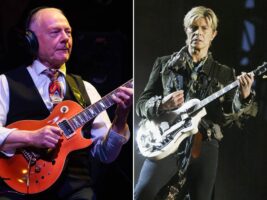
When King Crimson first disbanded in 1974, it seemed like Robert Fripp was ready to settle down in the Sherbourne countryside and withdraw from the limelight. However, David Bowie’s request for Fripp to feature on 1977’s Heroes put a halt to his temporary retirement – because, when Ziggy Stardust comes a-knocking, you can hardly turn him down.
While Fripp’s feedback-heavy, multi-layered guitar performance on Heroes is now iconic, Fripp thought that Bowie “took a chance” when he first enlisted him to feature on the track. “I didn’t view myself as a working player at that time, having just been in retreat for 10 months with no intention of going back to anything like that,” he admits in a new interview with Guitar World.
READ MORE: Alex Lifeson reveals the Rush song he “really struggled with” learning to play again for the band’s reunion: “My hands are not operating like they once did”
Although the King Crimson frontman wasn’t too optimistic, Bowie was adamant that he wanted Fripp. “When David asked me to provide guitar, I just said, ‘Well, I don’t know… but if you’re prepared to take a chance, so am I,’” the guitarist recalls.
The recording session saw Fripp flying out to Berlin’s Hansa Studios with his Les Paul, no amplifier, and a small selection of pedals (a volume pedal, a wah and a fuzz box). Despite his stripped back arsenal, Fripp still impressed Bowie and his producer, Tony Visconti; in a January interview with Guitar Player, Visconti recalled Fripp’s innovative ability to utilise studio monitor feedback as an instrument in and of itself.
That’s right – the EBow-like effect on Heroes is Fripp utilising monitor feedback. “Fripp had a technique in those days where he measured the distance between the guitar and the speaker where each note would feed back,” the producer explained. “For instance, an A would feed back maybe at about four feet from the speaker… He had a strip that they would place on the floor, and when he was playing the note F sharp he would stand on the strip’s F sharp point. and F sharp would feed back…”
Needless to say, Fripp nailed the job. Bowie loved his work so much that he even tried to bag Fripp as his full-time live guitarist – but Fripp kindly turned him down. He had ran away to a country home to escape touring, and even Bowie couldn’t tempt him to return to the stage just yet: “I just said, ‘No… I’ve just come off the road after six years of touring!’”
Despite his rejection, Bowie was keen to work with him again, asking Fripp to perform lead guitar parts across his 1980 record, Scary Monsters (and Super Creeps). On their second collaboration, Bowie knew he could ask anything of the talented Fripp – even if that meant asking him to embody the energy of another player.
“I remember I asked David, ‘Any suggestions?’ because there’s any number of ways you can go,” Fripp recalls in conversation with Guitar World. “He said, ‘Think Ritchie Blackmore’. I didn’t expect that, but I understood what he meant.”
Rather than outright copying Blackmore’s tone, Fripp captured the same aura and swagger of the Deep Purple legend. “Did I sound like Ritchie Blackmore? No,” he admits. “But I’d seen Ritchie in the Outlaws in Poole when I was 17, and his playing was phenomenal! He had all the moves. So I’d seen Ritchie, I’d heard Ritchie, and I wasn’t going to play like Ritchie would… but I knew what David meant!”
The post “If you’re prepared to take a chance, so am I”: how working with David Bowie helped lure Robert Fripp out of an early retirement appeared first on Guitar.com | All Things Guitar.
Source: www.guitar-bass.net