Fairlane Zephyr Review: “sell every guitar you own and buy one of these”
£3,480, fairlaneguitars.co.uk
Rock stars are famously demanding customers. And when it comes to their gear, who can blame them, really? After all, they’re the ones stepping out on stage in front of thousands of people every night, and the last thing they want is to look silly ’cause their guitar won’t stay in tune or something.
READ MORE: Harmony Standard Series Comet with Tremolo review: “This is a cool guitar that allows you to do your thing without trying to look like anybody else”
This is perhaps why the names of Kevin Williams and Reuben Gotto are mentioned with a certain knowing nod in the upper echelons of the UK guitar world. For a combined half a century, the pair have been taking care of the guitars of some of the biggest names on the planet – either on tour, or back in the workshop.
The pandemic was, to say the least, quite a rough time for people whose livelihoods were based on serving the needs of touring musicians, but it was out of this situation that the company that was originally called Providence Guitars was born.
As our recent cover feature with Williams and Gotto explained, they started doing repair work – first at homes and then in a dedicated space in London. The pair quickly built a reputation for stellar work, and before long the great and good of the capital’s guitar scene were clients. Inevitably, they started contemplating doing more than just set-ups and repairs.
The pair alighted on a Non-Reverse Firebird-inspired design called the Cardinal, and eventually evolved it into the more distinct guitar you see before you: the Zephyr.
It didn’t take long for the pair’s musician clientele to start asking questions about the weird guitars they had on the wall of their workshop. As word got around about how good these guitars were, in relatively no time at all they had an artist roster that much bigger brands would kill for: Ed O’Brien, Stuart Braithwaite, Conor Curley, Beabadoobee, Dallas Green… even Billy Bragg.
So, what’s all the fuss about?
Image: Adam Gasson
What is it?
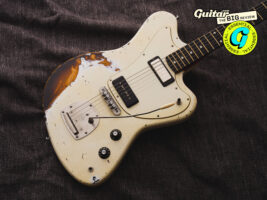
Like the Cardinal before it, the Zephyr is a guitar that clearly owes some of its visual identity to the oft-neglected Non-Reverse Firebird – a shape that is desperately in need of some love from Gibson and everyone else here in 2026, in my opinion.
The Zephyr takes the Firebird shape and makes it more overtly offset-y – there’s a more pronounced swoop down from the upper horn to the lower one, and the whole thing is a little more rounded and balanced as a result.
The headstock is a Firebird-style six-in-a-line affair, and the ebony ’board here has a Gibson-style 12-inch fingerboard radius, though that’s where the Gibson similarities end when it comes to the neck – the roasted maple neck is bolted on to the tempered pine body in Fender style, while the scale length is a longer 25.5-inch scale.
The hybrid Fender/Gibson vibe is continued on the body itself, where a Mastery bridge and Jazzmaster-style tremolo are paired with a simple Gibson-style two-pickup pairing. Here we have a custom Monty’s P-90 in the bridge with a Monty’s Firebird pickup in the neck.
In terms of looks, we have a stunning white-over-sunburst heavy relic job here, complete with heavy lacquer checking all over the body and headstock, while the neck has been sanded down to the wood across most of the usable area.
Fairlane guitars are made to order, so the spec options here are pretty broad. You can choose between pretty much any combination of Monty’s pickups you desire (Williams worked for Monty’s Matt Gleeson before he moved his operation out of London), various bridge and vibrato options, and of course whatever level of relic (or not) gets your particular rocks off.
My only tiny issue is that it sports a heel-adjust truss rod, which will make any seasonal adjustments more of a hassle than you’d like. That said, given the pair are vastly more qualified to talk about guitar maintenance than I am, I will assume there’s a good reason for that over a more straightforward adjustment option.
You can save yourself £200 and spec it without a case if you’re happy to go to London and pick it up, but this review model arrived in the reassuring embrace of a Mono M80 gig bag.
Image: Adam Gasson
Build Quality & Playability
Firstly, let me make this clear – the Zephyr is not a small guitar. Put atop my own Jazzmaster, it’s slightly longer thanks to that big ol’ headstock, and has more overall body mass thanks to chunkier horns. It’s also not a guitar that’s stripped down on the hardware front, rocking a set of vintage-style sealed-gear Gotoh tuners, and a full Jazzmaster-style bridge and tremolo.
I say this because somehow, this guitar weighs barely 7.4lbs – for an offset guitar of this size with this much hardware on it, that’s rather remarkable. This is no doubt greatly helped by the guitar’s tempered pine body – Dennis Fano has extolled the virtue of pine as a guitar body for some time now, and it’s great to see more makers use it.
The light weight hasn’t made the guitar unbalanced in any way, however – it sits much more comfortably than a Non-Reverse Firebird does in the lap, and there’s no hint of neck dive on a strap either. It’s supremely comfortable.
Comfort really is the order of the day when you start playing, too. As someone with smaller hands, I often wince when I see words like “chunky” used to describe a guitar’s neck profile, but here I needn’t have worried.
While there’s a little more heft than a generic C here, it’s a beautifully sympathetic carve that sits wonderfully in the hand – allowing you to really get hold of the thing without feeling like you’re going to have sore hands at the end of a long playing session.
And play it long, you will certainly want to, because the wonderfully sanded and oiled neck feels about as smooth and inviting as any guitar I’ve ever played – even where the finish transitions to gloss at the top end of the board, it’s still remarkably smooth and un-sticky.
The fretwork is absolutely flawless, with a beautifully executed transition from the ends into the rolled ’board edges – from the first fret to the 21st, you won’t find the merest hint of friction here.
Image: Adam Gasson
That also applies to the frets themselves, which are expertly levelled and polished – bends are as smooth as on any guitar I’ve ever played, with no hint of choking anywhere to be seen.
This guitar also earns bonus ‘pour one out’ points for rocking Jescar’s EvoGold fretwire – this halfway house between stainless steel and regular nickel-silver is beloved by luthiers because it’s easier to work with, but still very hard-wearing.
Unfortunately, the company that made the alloy used in its construction stopped producing it, so when current stocks of EvoGold are gone, that’s it. Reuben tells me they likely only have enough left over for another one or two builds, so if you want it – get in there asap!
You may well have strong feelings about artificially ageing guitars, and if you hate the look, I’m unlikely to convince you of its merits in a few sentences here. If you’re less closed off to such things, however, I can confirm that the finish job here is beautifully done – with nicely haphazard checking all over, and a very convincing colour-over-sunburst wear job, especially on the neck.
It looks great, in my opinion, but more importantly it all feels very worn in – like a broken-in pair of jeans, it adds an extra layer of playing comfort to an already very inviting instrument.
Image: Adam Gasson
Sounds
The Zephyr has a resonant and lively quality about it even before plugging in – the tempered pine vibrating rather tellingly across the guitar’s large body in a way that usually means good things.
You would expect that for the thick end of three grand you were going to get a great-sounding instrument. I’ve played plenty of expensive boutique guitars to know that this isn’t always the case, but generally good pickups plus good wood makes for an enjoyable sonic experience.
I wasn’t quite prepared for just how good the Zephyr sounds when plugged in. In fact, it’s the sort of transcendent guitar playing experience that will stick with me long after this guitar sadly heads back to Fairlane at the end of this test.
The combination of a P-90 and Firebird pickup is a well-known one of course – Neil Young’s Old Black has become legendary with this arrangement – but generally speaking it tends to be a P-90 in the neck and Firebird in the bridge.
Fairlane has flipped that script, and it might be a stroke of pure genius. Because what you’re left with then is the fat, humbucker-adjacent power of a P-90 screaming away like a great old Les Paul Junior, mixed with the brightly-accented precision of a Firebird pickup where things usually get woolly.
The results are some of the most compellingly balanced, articulate solidbody sounds I’ve ever heard. The Full Monty P-90 is a wonderfully snarly take on the classic P-90 formula – with more midrange punch and general output than a vintage unit, but still retaining the dynamics that make soapbars so beloved by many.
And then there’s the neck pickup. I have a colleague in this industry who will tell anyone who listens that the Firebird pickup is the most underrated and unfairly ignored pickup design of all. Brothers and sisters, I am a believer; come join me.
The genius here, I think, is that Monty’s take on the form is slightly overwound compared to a classic Firebird unit, meaning that it’s a little beefier and less shrill in practice, while still maintaining an impressive level of articulation.
Running through a Deluxe Reverb, both pickups offer warmth in abundance and subtly different flavours of chiming cleans – and wonderfully balanced with it. But it’s when you step on a dirt pedal that the true magic happens.
Fuzz especially really reveals the wonder of the Firebird neck pickup, delivering wonderfully punchy, scuzzy fuzz tones that still have a remarkable level of string-separation and clarity. You can get into the deepest Jack White or Dan Auerbach-shaped hole with this thing, and unlike almost any other neck pickup I’ve ever played, it neither shirks on the power nor loses itself in the noise.
The Mastery tremolo system only further encourages you into these sort of wig-outs, providing wonderfully musical and expressive wobbles to punctuate the impressive sustain as you let your notes ring out.
Image: Adam Gasson
Should I buy one?
There is a mindset that a lot of smaller boutique builders seem to hold that if you simply take the best possible raw materials and put them together in a logical way, an electric guitar worthy of boutique prices and boutique acclaim will magically appear at the end of it.
But the work of Kevin Williams and Reuben Gotto is a powerful reminder that a great electric guitar is so much more than the sum of its parts. Yes, the components and materials used here are first-class. Yes, it is a visually stunning instrument that threads the rare needle between vintage veneration and doing your own thing.
But the reason that the Fairlane Zephyr is one of the very finest electric guitars I’ve ever played is about so much more than that. It’s the informed craftsmanship that focuses on the small details that sets them and this guitar apart.
These are the details that separate good from great, and the pair’s wealth of high-level experience means they’re clearly aware of this. This sweating of the small stuff is what elevates this guitar to a level that very few small builders can operate at.
Unquestionably, this guitar is no small investment – but that doesn’t mean it’s not great value. You could take the better part of a grand off the price of this guitar by removing some of the cosmetic flourishes (like the heavy relic job) and bring it down to a price that’s not much more than the top end of Gibson and Fender’s USA production-line stuff.
And with respect to both brands, the level of workmanship and attention to detail on this Zephyr blows that out of the water. You’d have to go to the scarier end of the Custom Shop at both brands to get an instrument that feels close, and that’s gonna basically be double the price.
I’ve played a lot of great guitars in my time in this job, but I am also a killjoy – it’s vanishingly rare that I don’t find enough negatives to knock a mark or two off the score. This is not one of those occasions – the Fairlane Zephyr is a truly superlative instrument. Maybe those rock stars know what they’re on about…
Alternatives
The lack of Non-reverse Firebirds in the Gibson line-up is, frankly, a national disgrace, but there is one – the Gibson Custom 1965 Non-Reverse Firebird V Reissue ($4,499/£4,399) is a lovely bit of 60s nostalgia complete with two Firebird pickups and a Maestro Vibrola. Despite the boutique guitar world being a cornucopia of interesting and unconventional guitar designs, there’s a real dearth of Non-Reverse ‘Bird-inspired designs, but one really good one is the Fano Alt De Facto PX6 (from $3,499) – now under the stewardship of Dennis Fano again, one of the very finest builders on earth. If you want to keep it UK-based, the scene is in rude health right now. Trent’s Model 1 (from £2,095) is another cool offset thing with some big-name artist endorsement – Elliot Trent even machines his own unique JM-style tremolo system.
The post Fairlane Zephyr Review: “sell every guitar you own and buy one of these” appeared first on Guitar.com | All Things Guitar.
Source: www.guitar-bass.net